We advance your career through shared expertise and innovation. You influence the art and science of naval architecture. Join naval architects, maritime engineers and associated professionals in 140 countries.
Take 10 seconds to nominate a colleague, mentee or friend for our Forbes-style list. Must be under the age of 40 in 2026. Open to all maritime professions associated with naval architecture. See eligibility criteria. [hyperlinked].
Renowned for the technical excellence of our events, publications and learning, we offer career pathways for naval architects and 16 associated professions [hyperlink to 16 professions].
We cover everything from super yachts and green propulsion to warship resilience. Network 1-2-1 with top talent at our events or influence the maritime industry by joining one of our comittees.
We promote the interdisciplinary conversation at the heart of maritime innovation. Speak at our events, publish in our journals or simply join the discussion forums on our website.
?? HOW?? FILL IN EMAIL HERE AND SIGN UP WITH 1 CLICK

From flagship international conferences to specialist technical seminars, RINA events bring together experts, innovators, and professionals to share knowledge and shape the future of naval architecture.
Explore Upcoming Events
Lorem ipsum dolor sit amet, consectetur adipiscing elit, sed do eiusmod tempor incididunt ut labore et dolore magna aliqua.
CLICK HERE
Lorem ipsum dolor sit amet, consectetur adipiscing elit, sed do eiusmod tempor incididunt ut labore et dolore magna aliqua.
CLICK HERE
Contact Us
Lorem ipsum dolor sit amet, consectetur adipiscing elit. Aliquam aliquam arcu nec dictum cursus. Phasellus porttitor vitae mi vitae interdum. Fusce eu libero et eros pharetra posuere. Class aptent taciti sociosqu ad litora torquent per conubia nostra, per inceptos himenaeos.
 Facebook
 X/Twitter
 Instagram
 LinkedIn
 Facebook







Lorem ipsum dolor sit amet, consectetur adipiscing elit, sed do eiusmod tempor incididunt ut labore et dolore magna aliqua. Ut enim ad minim veniam, quis nostrud exercitation ullamco laboris nisi ut aliquip ex ea commodo consequat. Duis aute irure dolor in reprehenderit in voluptate velit esse cillum dolore eu fugiat nulla pariatur. Excepteur sint occaecat cupidatat non proident, sunt in culpa qui officia deserunt mollit anim id est laborum.

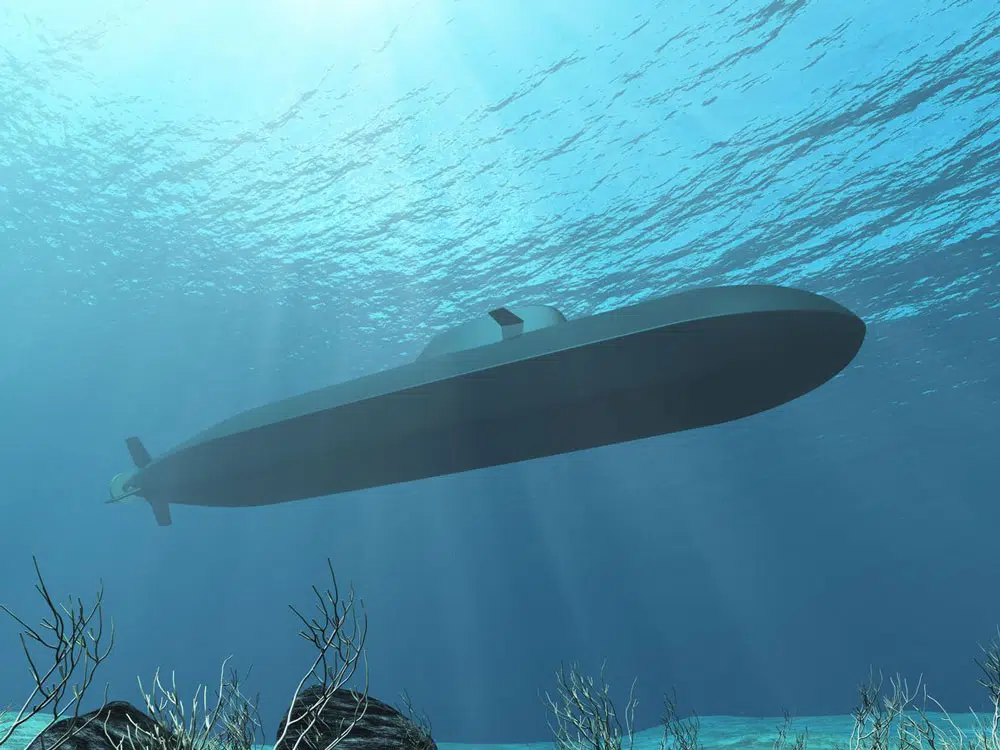
The Bundestag and the Federal Government have agreed to exercise an option to procure four more Type 212CD submarines for the German Navy. The contract for the new submarines, which are being acquired by the German Navy and Royal Norwegian Navy under a joint programme, is one of the largest secured by thyssenkrupp Marine Systems.
The deal was initialled by the president of the Bundeswehr Procurement Agency, Annette Lehnigk-Emden, and thyssenkrupp Marine Systems CEO Oliver Burkhard in late December 2024. Germany will now build six Type 212CDs. Norway has also recently signalled its intention to increase the number of submarines it builds under the joint programme from four to six.
Speaking as that deal was confirmed, Burkhard said: “A turning point in history is finally arriving in the maritime sector. We are delighted at the trust that the German government has once again placed in us with the additional order. We are making a decisive contribution to Germany’s response to changing times and strengthening our defence capabilities with this strategically important project between Germany and Norway.”
The Type 212CD submarines will be significantly more capable than the German Navy’s existing Type 212A boats, with enhanced situational awareness, superior networking with allied units and a reduced signature.
In advance of the construction of the submarines, thyssenkrupp Marine Systems has invested more than €250 million at the company’s yard in Kiel, including a new shipbuilding hall. The group has also acquired additional shipyard capacity at the former MV Werften site in Wismar, to be able to build submarines and surface vessels there at the same time.
“Our order books are well-filled and we are strongly positioned nationally and internationally,” said Burkhard, noting that now that the number of Type 212CD submarines on order has been increased, other countries could join the project in the near future. “Our strong position has now become even stronger,” he concluded.
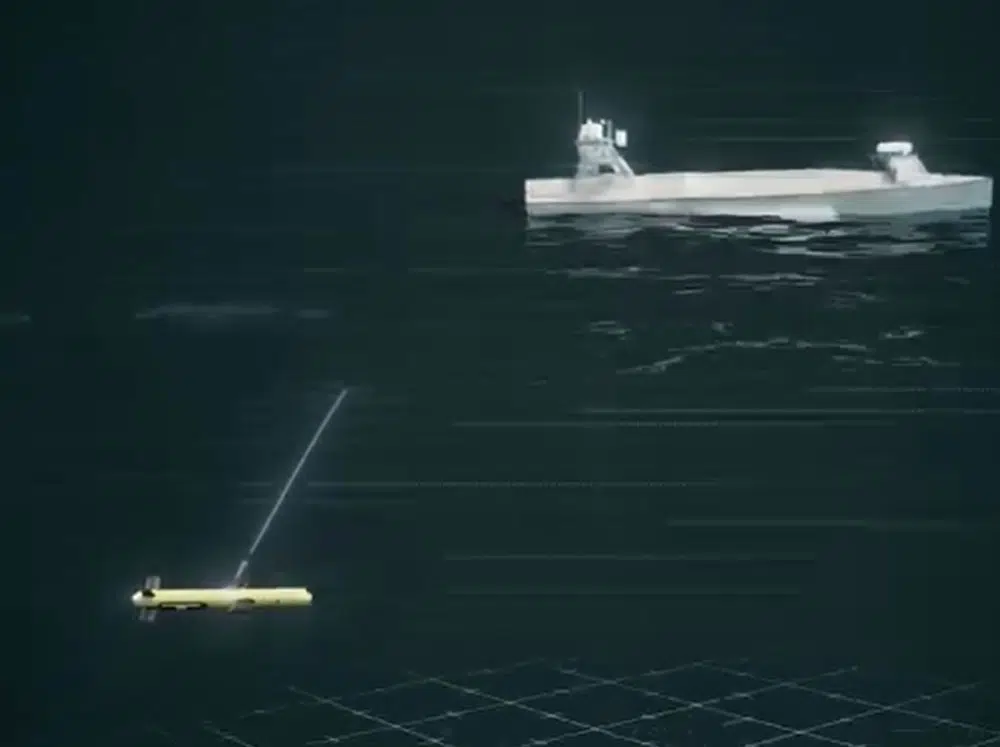
A team-up between boatbuilder/USV manufacturer Tuco Marine and maritime survey tech company EIVA aims to establish an all-in-one autonomous package for subsea asset inspections, matching a Tuco-built ProZero 8m Naval Intelligence USV to EIVA’s ViperFish remotely operated towed vehicle (ROTV).
In practice, the USV would sail to an area of interest, towing and remotely launching the ViperFish. The ViperFish would be equipped with sensors and survey software, and would undertake high-resolution seabed imaging, with area coverage rates of 1.6km2/hr, while using magnetic signals to monitor subsea assets, such as power cables.
Jonas Pedersen, MD of Tuco Marine, comments: “By combining…our ProZero with EIVA’s ROTV, it’s possible to monitor the conditions of critical subsea infrastructure much more thoroughly and frequently than with conventional set-ups.”
Launched in 2023, the ViperFish measures 3,200mm x 1,300mm x 620mm and is rated for depths descending to 200m. The ROTV is designed for surveys at 2-10knots, and has a reported target positioning accuracy of 1m. EIVA suggests that, when integrated with an USV, the ViperFish can also be used for mine countermeasures, rapid environmental assessment, surveillance and salvage missions.
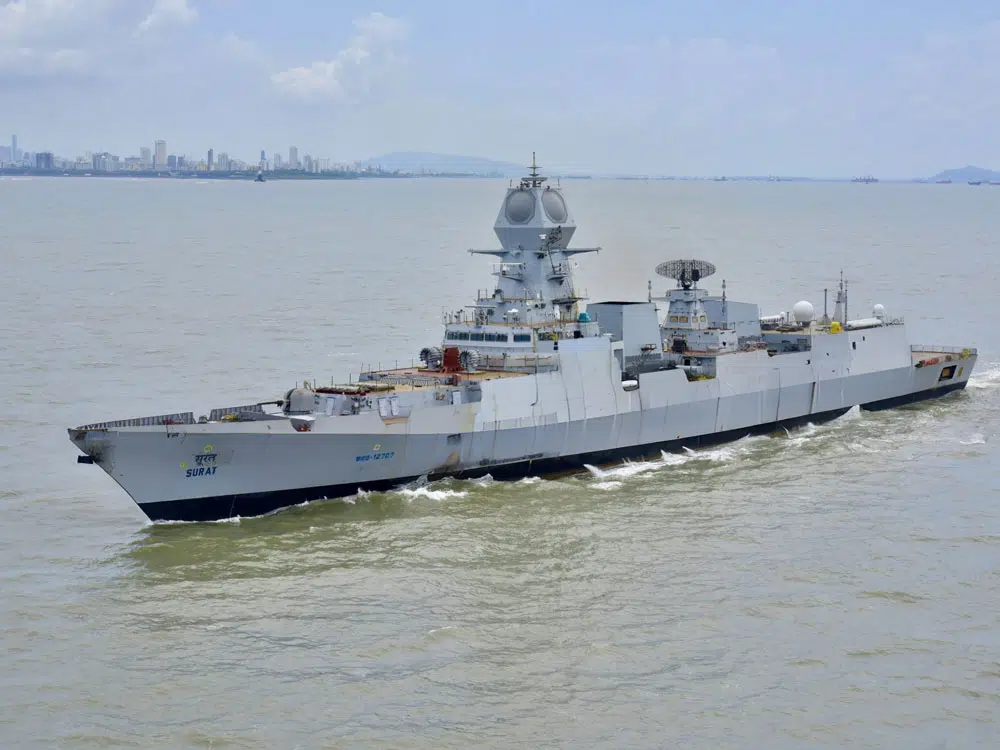
The commissioning this week of three frontline naval vessels by the Indian Navy marks a “significant milestone in India’s shipbuilding and design capabilities”, according to analytics firm GlobalData.
January 15 saw the entries of INS Surat (163m), the fourth and final unit of the Visakhapatnam class of stealth guided-missile destroyers; INS Nilgiri (149m), the lead ship of the Nilgiri class of stealth guided-missile frigates; and INS Vagsheer (67.5m), the sixth of six Kalvari-class diesel-electric submarines. The vessels were constructed by Mazagon Dock Shipbuilders Limited (MDL), Mumbai.
Rithik Rao, aerospace and defence analyst at GlobalData, writes: “Armed with advanced weaponry such as BrahMos and Barak 8 missiles, both INS Surat and INS Nilgiri provide the Indian Navy with enhanced anti-surface and anti-air warfare capabilities, excelling in both offensive and defensive roles.
“INS Vagsheer excels in a range of operations, including anti-surface and anti-submarine warfare, intelligence gathering and area surveillance. Together, these domestically built platforms demonstrate India’s growing competence in developing cutting-edge naval technologies, thereby strengthening its maritime security and reinforcing its strategic autonomy in defence production.”
Rao adds that India has felt the need to step up its naval defence capabilities due to “the increasing maritime presence” of the Chinese People’s Liberation Army Navy (PLA Navy) in the Indian Ocean Region. “[India] is trying to catch up with its Chinese counterparts in terms of quantity and technology advancements,” Rao says. GlobalData has forecast that India will spend just over US$35 billion on various domestically built naval vessels and subs in the run-up to 2029.
“Shipbuilders such as MDL stand to benefit significantly, leveraging the expertise gained from constructing complex naval platforms,” says Rao. “Such advancements will lay a strong foundation for future collaborations between major domestic defence contractors and many small and medium suppliers in upcoming next-generation submarine and naval vessel construction programmes, ensuring the Indian Navy remains well-equipped to meet evolving challenges in the upcoming decades.”
Speaking at the commissioning ceremony, Indian prime minister Narender Modi commented: “I am happy that our Navy has expanded the ‘Make In India’ campaign to a great extent. In the last 10 years, 33 ships and seven submarines have been inducted into the Indian Navy. Out of these 40 naval vessels, 39 have been built in Indian shipyards.
“Along with increasing the strength of the Indian armed forces, ‘Make In India’ is also opening new doors of economic progress. The shipbuilding ecosystem is an example. Experts also say that the more investment is made in shipbuilding, the more positive impact it has on the economy.”
The International Association of Classification Societies (IACS) has published a new recommendation, titled Rec. 182, to provide a “comprehensive framework” to support the adoption of onshore power supply (OPS) systems.
Rec. 182 was drawn up to provide “detailed guidance for ship designers, builders, operators and owners on integrating OPS systems into both newbuilds and retrofits, while addressing the technical and operational challenges associated with its implementation”, IACS states. The recommendation is intended to complement IMO’s MSC.1/Circ.1675 – Interim Guidelines on the Safe Operation of OPS Service in Port for Ships Engaged on International Voyages, IACS adds.
Subsequently, Rec. 182 outlines aspects such as: ship requirements for OPS; ship-to-shore connection protocols, with an emphasis on safe connection and disconnection; and testing procedures, for both the first connection and periodic check-ups. IACS states: “At the first call at a shore supply point, ships should undergo mandatory tests, including visual inspections, insulation resistance measurements, functional tests of protection devices and integration tests, to ensure proper operation between ship and shore installations.
“If the time between repeated port calls does not exceed 12 months and no modifications have been made, only limited verification tests are required. However, if the interval exceeds 12 months, comprehensive testing as outlined in the document should be conducted.”
Rec. 182 also covers operational safety measures, including the use of suitable PPE, plus ensuring “effective communication” between shipboard crew and shoreside personnel during connection/disconnection procedures. Documentation of OPS operation procedures – which would include circuit diagrams, compatibility assessments and emergency shutdown protocols – is also underscored in the recommendation, as is a pre-connection safety checklist.
IACS says: “The shift towards decarbonisation has placed a spotlight on reducing emissions from seagoing vessels while at ports, where vessels often rely on auxiliary engines that contribute to greenhouse gas [GHG] emissions. OPS, commonly referred to as ‘cold ironing’ or shore-to-ship power, has emerged as a promising solution, allowing vessels to connect to a land-based electrical grid while at berth, enabling their onboard generators to be switched off.” Cold ironing has been credited with significantly cuttting NOx and SOx emissions, plus particulate matter (PM) levels, in port areas, enabling the future development of sustainable ports.
Rec. 182 can be accessed at the IACS website.
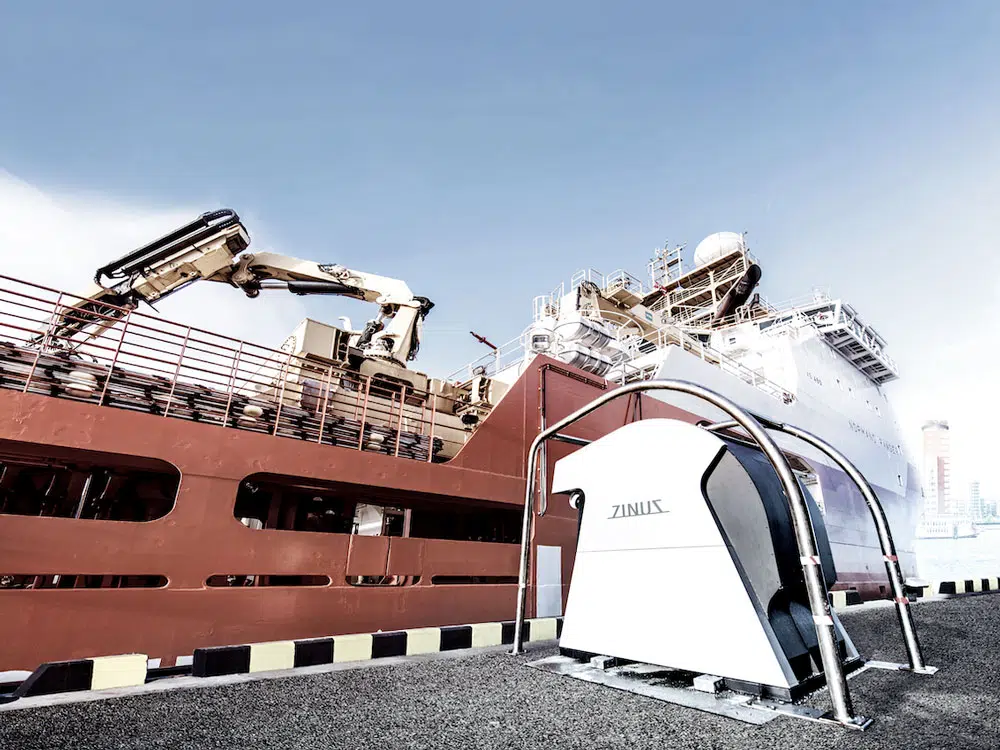
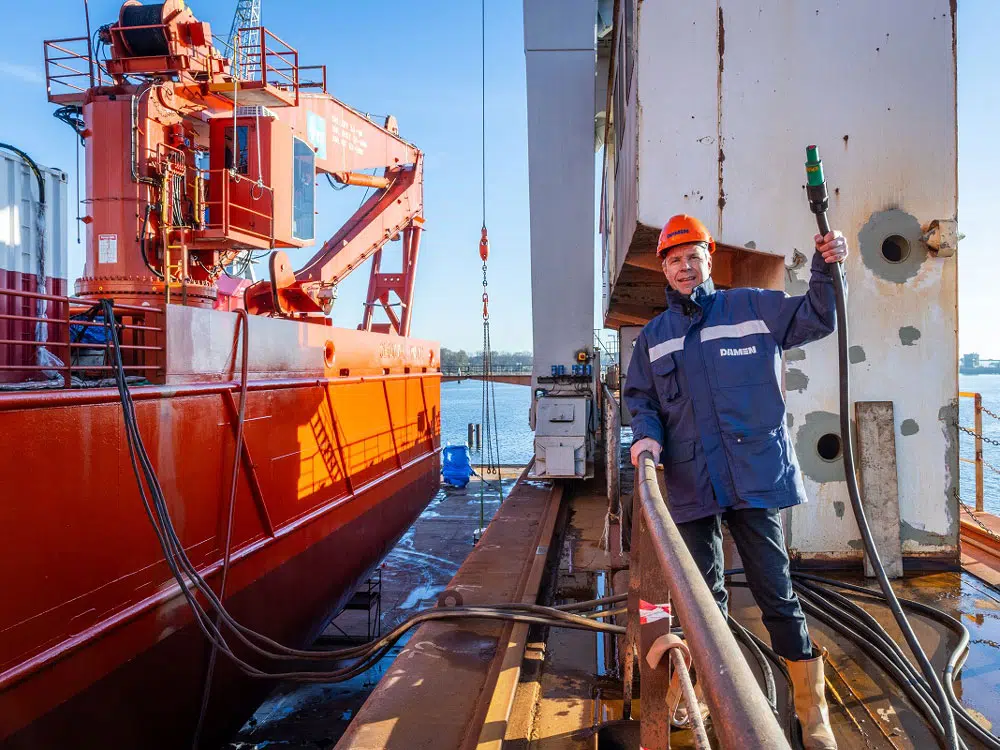
Damen Shiprepair Oranjewerf is strengthening its commitment to green ship repair, maintenance, conversion and refit projects with a recent shore power installation. The yard had already installed a shore power unit which was suited to many of its projects. However, with this latest installation, developed by Elma Systems, the availability of clean onshore power, converted to 60Hz, has been widened to cover all types of vessel that call at the yard.
Commercial manager Jeen van der Werf explains: “Previously, we were able to provide shore power at 50Hz. However, we get a lot of offshore, navy and fishing vessels come to the yard for work, and many of these vessels operate on 60Hz.” As a result, he says, the yard often had to hire in a diesel-powered generator; something the company was keen to avoid.
Damen Shiprepair Oranjewerf began discussions with Elma Systems to address this issue. Together, the two companies set about the development of a solution that was more in tune with the yard’s needs, and Elma came up with a rotary convertor, which converts the shore power to the desired 60Hz rating.
The shore power system, which is installed on the yard’s floating dock, can support up to 250kVA. Should more power be required, there is an option to add a battery or secondary power source. The Elma-designed rotary converter is therefore also equipped with a load sharing system.
With this new shore power system now fully operational, Damen Shiprepair Oranjewerf expects to significantly reduce its carbon emissions. As an additional benefit, the wider use of shore power means that the yard no longer has to hire in costly diesel generators, and is, therefore, able to offer its clients a more competitively priced project.

Lorem ipsum dolor sit amet, consectetur adipiscing elit, sed do eiusmod tempor incididunt ut labore et dolore magna aliqua. Ut enim ad minim veniam, quis nostrud exercitation ullamco laboris nisi ut aliquip ex ea commodo consequat. Duis aute irure dolor in reprehenderit in voluptate velit esse cillum dolore eu fugiat nulla pariatur. Excepteur sint occaecat cupidatat non proident, sunt in culpa qui officia deserunt mollit anim id est laborum.
Lorem ipsum dolor sit amet, consectetur adipiscing elit, sed do eiusmod tempor incididunt ut labore et dolore magna aliqua. Ut enim ad minim veniam, quis nostrud exercitation ullamco laboris nisi ut aliquip ex ea commodo consequat. Duis aute irure dolor in reprehenderit in voluptate velit esse cillum dolore eu fugiat nulla pariatur. Excepteur sint occaecat cupidatat non proident, sunt in culpa qui officia deserunt mollit anim id est laborum.
Lorem ipsum dolor sit amet, consectetur adipiscing elit, sed do eiusmod tempor incididunt ut labore et dolore magna aliqua. Ut enim ad minim veniam, quis nostrud exercitation ullamco laboris nisi ut aliquip ex ea commodo consequat. Duis aute irure dolor in reprehenderit in voluptate velit esse cillum dolore eu fugiat nulla pariatur. Excepteur sint occaecat cupidatat non proident, sunt in culpa qui officia deserunt mollit anim id est laborum.
Lorem ipsum dolor sit amet, consectetur adipiscing elit, sed do eiusmod tempor incididunt ut labore et dolore magna aliqua. Ut enim ad minim veniam, quis nostrud exercitation ullamco laboris nisi ut aliquip ex ea commodo consequat. Duis aute irure dolor in reprehenderit in voluptate velit esse cillum dolore eu fugiat nulla pariatur. Excepteur sint occaecat cupidatat non proident, sunt in culpa qui officia deserunt mollit anim id est laborum.
Lorem ipsum dolor sit amet, consectetur adipiscing elit, sed do eiusmod tempor incididunt ut labore et dolore magna aliqua. Ut enim ad minim veniam, quis nostrud exercitation ullamco laboris nisi ut aliquip ex ea commodo consequat. Duis aute irure dolor in reprehenderit in voluptate velit esse cillum dolore eu fugiat nulla pariatur. Excepteur sint occaecat cupidatat non proident, sunt in culpa qui officia deserunt mollit anim id est laborum.
Lorem ipsum dolor sit amet, consectetur adipiscing elit, sed do eiusmod tempor incididunt ut labore et dolore magna aliqua. Ut enim ad minim veniam, quis nostrud exercitation ullamco laboris nisi ut aliquip ex ea commodo consequat. Duis aute irure dolor in reprehenderit in voluptate velit esse cillum dolore eu fugiat nulla pariatur. Excepteur sint occaecat cupidatat non proident, sunt in culpa qui officia deserunt mollit anim id est laborum.
text one
Lorem ipsum dolor sit amet, consectetur adipiscing elit, sed do eiusmod tempor incididunt ut labore et dolore magna aliqua. Ut enim ad minim veniam, quis nostrud exercitation ullamco laboris nisi ut aliquip ex ea commodo consequat. Duis aute irure dolor in reprehenderit in voluptate velit esse cillum dolore eu fugiat nulla pariatur. Excepteur sint occaecat cupidatat non proident, sunt in culpa qui officia deserunt mollit anim id est laborum.