40 under 40

Take 10 seconds to nominate a colleague, mentee or friend for our Forbes-style list. Must be under the age of 40 in 2026. Open to all maritime professions associated with naval architecture. See eligibility criteria. [hyperlinked].  
 

Nominate with LinkedIn profile 


JOIN TO ADVANCE

Renowned for the technical excellence of our events, publications and learning, we offer career pathways for naval architects and 16 associated professions [hyperlink to 16 professions].

join to influence

We cover everything from super yachts and green propulsion to warship resilience. Network 1-2-1 with top talent at our events or influence the maritime industry by joining one of our comittees.  

JOIN TO INNOVATE

We promote the interdisciplinary conversation at the heart of maritime innovation. Speak at our events, publish in our journals or simply join the discussion forums on our website.  

Not quite ready to join yet? 


?? HOW?? FILL IN EMAIL HERE AND SIGN UP WITH 1 CLICK 

DISCOVER

View All

>

Sixth AAL Super B-class heavy-lifter ready for action

Detail Link
>

Low-NOx tug on order for New Zealand

Detail Link
>

Metal Shark fireboat to boost safety in Tampa Bay

Detail Link
>

'Carbon Destroyer 1' launched as 'virtual CO2 pipeline'

Detail Link
>

New firefighter signs up for duty in Singapore

Detail Link
>

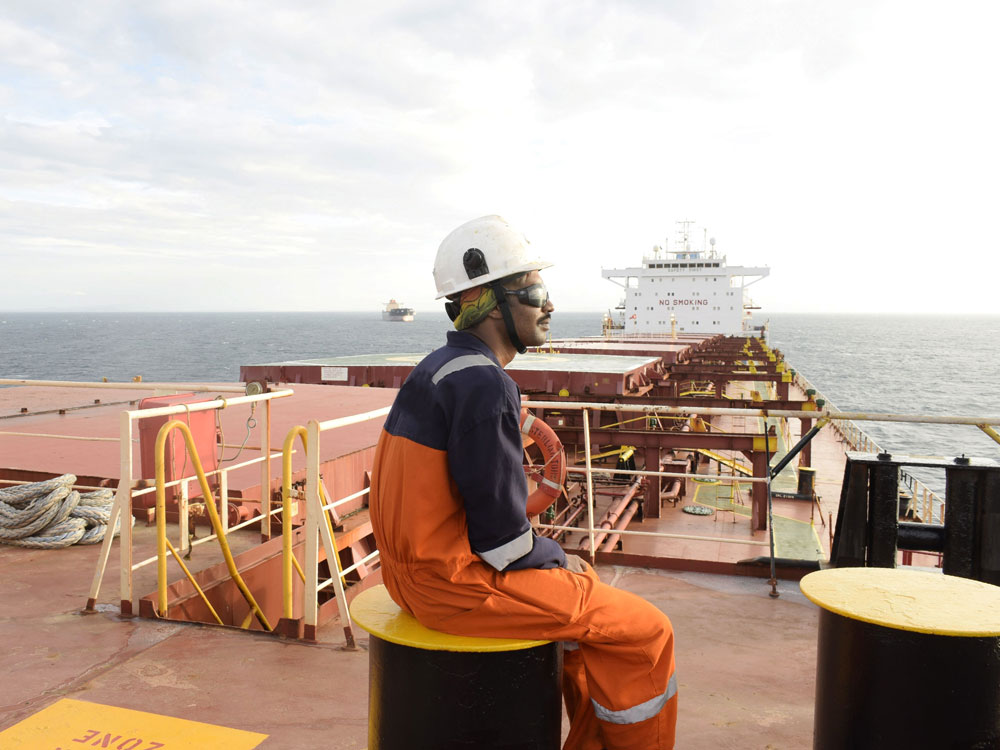
Ignored: the silent tide of suicide at sea

Detail Link
>

A new 'Guardian' emerges - in CTV form

Detail Link
>

Sir Thomas Slade: Nelson's naval architect

Detail Link
>

UK USV developers fighting to thrive

Detail Link
>

Bolidt solutions high on the decking order for RCI

Detail Link


???HOW??? what is the best slice to display TESTIMONIALS [LARGE photo + COLOURED BACKGROUND with LARGE quote imposed over it?]

  • Graduate Naval Architect [eg. Aidan Atkinson]

  • Prime Career [eg. Chris Nair]

  • Iconic Status and Giving back to Global Community [eg. Ian Buxton]

 
Global Events Connecting Maritime Leaders


Events


From flagship international conferences to specialist technical seminars, RINA events bring together experts, innovators, and professionals to share knowledge and shape the future of naval architecture.


Explore Upcoming Events
Events

Lorem ipsum dolor sit amet, consectetur adipiscing elit, sed do eiusmod tempor incididunt ut labore et dolore magna aliqua. Ut enim ad minim veniam, quis nostrud exercitation ullamco laboris nisi ut aliquip ex ea commodo consequat. Duis aute irure dolor in reprehenderit in voluptate velit esse cillum dolore eu fugiat nulla pariatur. Excepteur sint occaecat cupidatat non proident, sunt in culpa qui officia deserunt mollit anim id est laborum.

View All

CORPORATE PARTNERS

Using AI to fast-track maritime nuclear licensing
Ship repair and retrofit trends boost Seatrium
SPONSORED: FleetguardFIT™ Reduces Service Cost by 50% for Marine Customer
Alt-fuel adoption on the ascent, DNV notes
Green Marine dives deep with new subsea-focused investment
Fincantieri stacks up cruise build and repair work
New Logistics Support Ship designs from Damen
Call for UK to exploit 'unique' nuclear opportunity
Build it smart: UK yards must tackle AI and robotics skills gap
Heavy-lift muscle for Japanese wind farms
Four more Type 212CD subs for German Navy
Drones partner up for subsea asset checks
"Significant milestone" for homebuilt Indian Navy vessels
New IACS recommendation for shore-to-ship power
Damen repair division invests further in sustainability

HEADING


Lorem ipsum dolor sit amet, consectetur adipiscing elit, sed do eiusmod tempor incididunt ut labore et dolore magna aliqua.


CLICK HERE

HEADING


Lorem ipsum dolor sit amet, consectetur adipiscing elit, sed do eiusmod tempor incididunt ut labore et dolore magna aliqua.


CLICK HERE

Contact Us

Get in touch

Lorem ipsum dolor sit amet, consectetur adipiscing elit. Aliquam aliquam arcu nec dictum cursus. Phasellus porttitor vitae mi vitae interdum. Fusce eu libero et eros pharetra posuere. Class aptent taciti sociosqu ad litora torquent per conubia nostra, per inceptos himenaeos.

Lorem ipsum dolor sit amet, consectetur adipiscing elit, sed do eiusmod tempor incididunt ut labore et dolore magna aliqua. Ut enim ad minim veniam, quis nostrud exercitation ullamco laboris nisi ut aliquip ex ea commodo consequat. Duis aute irure dolor in reprehenderit in voluptate velit esse cillum dolore eu fugiat nulla pariatur. Excepteur sint occaecat cupidatat non proident, sunt in culpa qui officia deserunt mollit anim id est laborum.

The Bundestag and the Federal Government have agreed to exercise an option to procure four more Type 212CD submarines for the German Navy. The contract for the new submarines, which are being acquired by the German Navy and Royal Norwegian Navy under a joint programme, is one of the largest secured by thyssenkrupp Marine Systems.

The deal was initialled by the president of the Bundeswehr Procurement Agency, Annette Lehnigk-Emden, and thyssenkrupp Marine Systems CEO Oliver Burkhard in late December 2024. Germany will now build six Type 212CDs. Norway has also recently signalled its intention to increase the number of submarines it builds under the joint programme from four to six.

Speaking as that deal was confirmed, Burkhard said: “A turning point in history is finally arriving in the maritime sector. We are delighted at the trust that the German government has once again placed in us with the additional order. We are making a decisive contribution to Germany’s response to changing times and strengthening our defence capabilities with this strategically important project between Germany and Norway.”

The Type 212CD submarines will be significantly more capable than the German Navy’s existing Type 212A boats, with enhanced situational awareness, superior networking with allied units and a reduced signature.

In advance of the construction of the submarines, thyssenkrupp Marine Systems has invested more than €250 million at the company’s yard in Kiel, including a new shipbuilding hall. The group has also acquired additional shipyard capacity at the former MV Werften site in Wismar, to be able to build submarines and surface vessels there at the same time.

“Our order books are well-filled and we are strongly positioned nationally and internationally,” said Burkhard, noting that now that the number of Type 212CD submarines on order has been increased, other countries could join the project in the near future. “Our strong position has now become even stronger,” he concluded.

A team-up between boatbuilder/USV manufacturer Tuco Marine and maritime survey tech company EIVA aims to establish an all-in-one autonomous package for subsea asset inspections, matching a Tuco-built ProZero 8m Naval Intelligence USV to EIVA’s ViperFish remotely operated towed vehicle (ROTV).

In practice, the USV would sail to an area of interest, towing and remotely launching the ViperFish. The ViperFish would be equipped with sensors and survey software, and would undertake high-resolution seabed imaging, with area coverage rates of 1.6km2/hr,  while using magnetic signals to monitor subsea assets, such as power cables.

Jonas Pedersen, MD of Tuco Marine, comments: “By combining…our ProZero with EIVA’s ROTV, it’s possible to monitor the conditions of critical subsea infrastructure much more thoroughly and frequently than with conventional set-ups.”

Launched in 2023, the ViperFish measures 3,200mm x 1,300mm x 620mm and is rated for depths descending to 200m. The ROTV is designed for surveys at 2-10knots, and has a reported target positioning accuracy of 1m. EIVA suggests that, when integrated with an USV, the ViperFish can also be used for mine countermeasures, rapid environmental assessment, surveillance and salvage missions.

The commissioning this week of three frontline naval vessels by the Indian Navy marks a “significant milestone in India’s shipbuilding and design capabilities”, according to analytics firm GlobalData.

January 15 saw the entries of INS Surat (163m), the fourth and final unit of the Visakhapatnam class of stealth guided-missile destroyers; INS Nilgiri (149m), the lead ship of the Nilgiri class of stealth guided-missile frigates; and INS Vagsheer (67.5m), the sixth of six Kalvari-class diesel-electric submarines. The vessels were constructed by Mazagon Dock Shipbuilders Limited (MDL), Mumbai.

Rithik Rao, aerospace and defence analyst at GlobalData, writes: “Armed with advanced weaponry such as BrahMos and Barak 8 missiles, both INS Surat and INS Nilgiri provide the Indian Navy with enhanced anti-surface and anti-air warfare capabilities, excelling in both offensive and defensive roles.

“INS Vagsheer excels in a range of operations, including anti-surface and anti-submarine warfare, intelligence gathering and area surveillance. Together, these domestically built platforms demonstrate India’s growing competence in developing cutting-edge naval technologies, thereby strengthening its maritime security and reinforcing its strategic autonomy in defence production.”

Rao adds that India has felt the need to step up its naval defence capabilities due to “the increasing maritime presence” of the Chinese People’s Liberation Army Navy (PLA Navy) in the Indian Ocean Region. “[India] is trying to catch up with its Chinese counterparts in terms of quantity and technology advancements,” Rao says. GlobalData has forecast that India will spend just over US$35 billion on various domestically built naval vessels and subs in the run-up to 2029.

“Shipbuilders such as MDL stand to benefit significantly, leveraging the expertise gained from constructing complex naval platforms,” says Rao. “Such advancements will lay a strong foundation for future collaborations between major domestic defence contractors and many small and medium suppliers in upcoming next-generation submarine and naval vessel construction programmes, ensuring the Indian Navy remains well-equipped to meet evolving challenges in the upcoming decades.”

Speaking at the commissioning ceremony, Indian prime minister Narender Modi commented: “I am happy that our Navy has expanded the ‘Make In India’ campaign to a great extent. In the last 10 years, 33 ships and seven submarines have been inducted into the Indian Navy. Out of these 40 naval vessels, 39 have been built in Indian shipyards.

“Along with increasing the strength of the Indian armed forces, ‘Make In India’ is also opening new doors of economic progress. The shipbuilding ecosystem is an example. Experts also say that the more investment is made in shipbuilding, the more positive impact it has on the economy.”

The International Association of Classification Societies (IACS) has published a new recommendation, titled Rec. 182, to provide a “comprehensive framework” to support the adoption of onshore power supply (OPS) systems.

Rec. 182 was drawn up to provide “detailed guidance for ship designers, builders, operators and owners on integrating OPS systems into both newbuilds and retrofits, while addressing the technical and operational challenges associated with its implementation”, IACS states. The recommendation is intended to complement IMO’s MSC.1/Circ.1675 – Interim Guidelines on the Safe Operation of OPS Service in Port for Ships Engaged on International Voyages, IACS adds.

Subsequently, Rec. 182 outlines aspects such as: ship requirements for OPS; ship-to-shore connection protocols, with an emphasis on safe connection and disconnection; and testing procedures, for both the first connection and periodic check-ups. IACS states: “At the first call at a shore supply point, ships should undergo mandatory tests, including visual inspections, insulation resistance measurements, functional tests of protection devices and integration tests, to ensure proper operation between ship and shore installations.

“If the time between repeated port calls does not exceed 12 months and no modifications have been made, only limited verification tests are required. However, if the interval exceeds 12 months, comprehensive testing as outlined in the document should be conducted.”

Rec. 182 also covers operational safety measures, including the use of suitable PPE, plus ensuring “effective communication” between shipboard crew and shoreside personnel during connection/disconnection procedures. Documentation of OPS operation procedures – which would include circuit diagrams, compatibility assessments and emergency shutdown protocols – is also underscored in the recommendation, as is a pre-connection safety checklist.

IACS says: “The shift towards decarbonisation has placed a spotlight on reducing emissions from seagoing vessels while at ports, where vessels often rely on auxiliary engines that contribute to greenhouse gas [GHG] emissions. OPS, commonly referred to as ‘cold ironing’ or shore-to-ship power, has emerged as a promising solution, allowing vessels to connect to a land-based electrical grid while at berth, enabling their onboard generators to be switched off.” Cold ironing has been credited with significantly cuttting NOx and SOx emissions, plus particulate matter (PM) levels, in port areas, enabling the future development of sustainable ports.

Rec. 182 can be accessed at the IACS website.

Damen Shiprepair Oranjewerf is strengthening its commitment to green ship repair, maintenance, conversion and refit projects with a recent shore power installation. The yard had already installed a shore power unit which was suited to many of its projects. However, with this latest installation, developed by Elma Systems, the availability of clean onshore power, converted to 60Hz, has been widened to cover all types of vessel that call at the yard.

Commercial manager Jeen van der Werf explains: “Previously, we were able to provide shore power at 50Hz. However, we get a lot of offshore, navy and fishing vessels come to the yard for work, and many of these vessels operate on 60Hz.” As a result, he says, the yard often had to hire in a diesel-powered generator; something the company was keen to avoid.

Damen Shiprepair Oranjewerf began discussions with Elma Systems to address this issue. Together, the two companies set about the development of a solution that was more in tune with the yard’s needs, and Elma came up with a rotary convertor, which converts the shore power to the desired 60Hz rating.

The shore power system, which is installed on the yard’s floating dock, can support up to 250kVA. Should more power be required, there is an option to add a battery or secondary power source. The Elma-designed rotary converter is therefore also equipped with a load sharing system.

With this new shore power system now fully operational, Damen Shiprepair Oranjewerf expects to significantly reduce its carbon emissions. As an additional benefit, the wider use of shore power means that the yard no longer has to hire in costly diesel generators, and is, therefore, able to offer its clients a more competitively priced project.

Frequently Asked Questions

Lorem ipsum dolor sit amet, consectetur adipiscing elit, sed do eiusmod tempor incididunt ut labore et dolore magna aliqua. Ut enim ad minim veniam, quis nostrud exercitation ullamco laboris nisi ut aliquip ex ea commodo consequat.

Tab1

Lorem ipsum dolor sit amet, consectetur adipiscing elit, sed do eiusmod tempor incididunt ut labore et dolore magna aliqua. Ut enim ad minim veniam, quis nostrud exercitation ullamco laboris nisi ut aliquip ex ea commodo consequat. Duis aute irure dolor in reprehenderit in voluptate velit esse cillum dolore eu fugiat nulla pariatur. Excepteur sint occaecat cupidatat non proident, sunt in culpa qui officia deserunt mollit anim id est laborum.

Tab2

Lorem ipsum dolor sit amet, consectetur adipiscing elit, sed do eiusmod tempor incididunt ut labore et dolore magna aliqua. Ut enim ad minim veniam, quis nostrud exercitation ullamco laboris nisi ut aliquip ex ea commodo consequat. Duis aute irure dolor in reprehenderit in voluptate velit esse cillum dolore eu fugiat nulla pariatur. Excepteur sint occaecat cupidatat non proident, sunt in culpa qui officia deserunt mollit anim id est laborum.

Frequently Asked Questions

Lorem ipsum dolor sit amet, consectetur adipiscing elit, sed do eiusmod tempor incididunt ut labore et dolore magna aliqua. Ut enim ad minim veniam, quis nostrud exercitation ullamco laboris nisi ut aliquip ex ea commodo consequat.

Tab1

Lorem ipsum dolor sit amet, consectetur adipiscing elit, sed do eiusmod tempor incididunt ut labore et dolore magna aliqua. Ut enim ad minim veniam, quis nostrud exercitation ullamco laboris nisi ut aliquip ex ea commodo consequat. Duis aute irure dolor in reprehenderit in voluptate velit esse cillum dolore eu fugiat nulla pariatur. Excepteur sint occaecat cupidatat non proident, sunt in culpa qui officia deserunt mollit anim id est laborum.

Tab2

Lorem ipsum dolor sit amet, consectetur adipiscing elit, sed do eiusmod tempor incididunt ut labore et dolore magna aliqua. Ut enim ad minim veniam, quis nostrud exercitation ullamco laboris nisi ut aliquip ex ea commodo consequat. Duis aute irure dolor in reprehenderit in voluptate velit esse cillum dolore eu fugiat nulla pariatur. Excepteur sint occaecat cupidatat non proident, sunt in culpa qui officia deserunt mollit anim id est laborum.

Tab3

Lorem ipsum dolor sit amet, consectetur adipiscing elit, sed do eiusmod tempor incididunt ut labore et dolore magna aliqua. Ut enim ad minim veniam, quis nostrud exercitation ullamco laboris nisi ut aliquip ex ea commodo consequat. Duis aute irure dolor in reprehenderit in voluptate velit esse cillum dolore eu fugiat nulla pariatur. Excepteur sint occaecat cupidatat non proident, sunt in culpa qui officia deserunt mollit anim id est laborum.

Tab4

Lorem ipsum dolor sit amet, consectetur adipiscing elit, sed do eiusmod tempor incididunt ut labore et dolore magna aliqua. Ut enim ad minim veniam, quis nostrud exercitation ullamco laboris nisi ut aliquip ex ea commodo consequat. Duis aute irure dolor in reprehenderit in voluptate velit esse cillum dolore eu fugiat nulla pariatur. Excepteur sint occaecat cupidatat non proident, sunt in culpa qui officia deserunt mollit anim id est laborum.

text one

Lorem ipsum dolor sit amet, consectetur adipiscing elit, sed do eiusmod tempor incididunt ut labore et dolore magna aliqua. Ut enim ad minim veniam, quis nostrud exercitation ullamco laboris nisi ut aliquip ex ea commodo consequat. Duis aute irure dolor in reprehenderit in voluptate velit esse cillum dolore eu fugiat nulla pariatur. Excepteur sint occaecat cupidatat non proident, sunt in culpa qui officia deserunt mollit anim id est laborum.

Sixth AAL Super B-class heavy-lifter ready for action

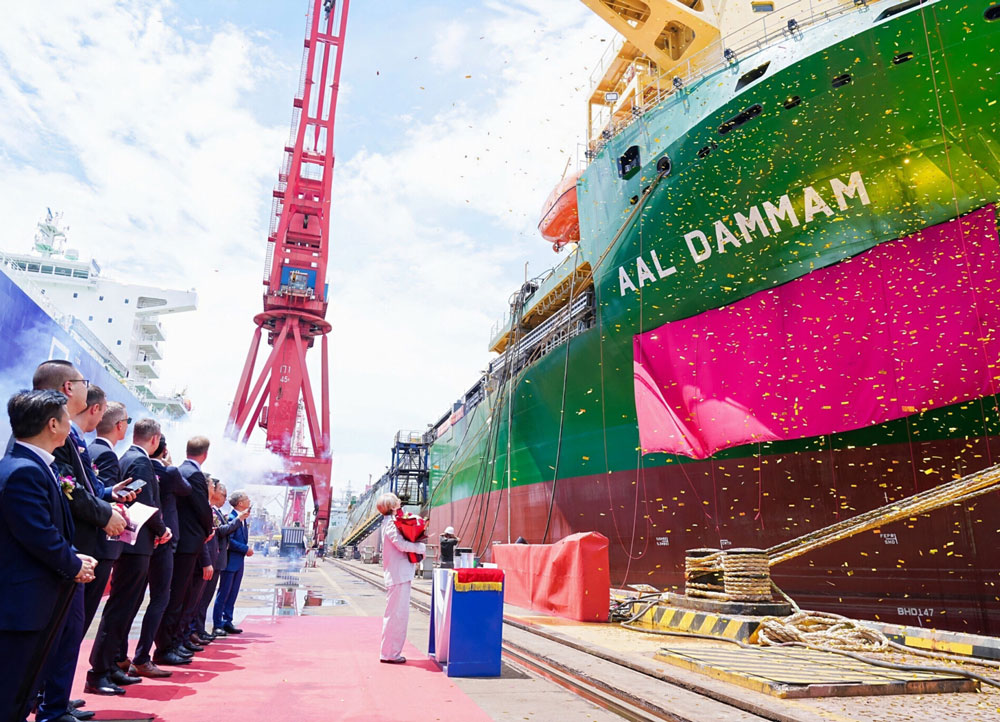
Heavy-lift vessel operator AAL Shipping (AAL) says it is preparing to take delivery of the sixth in a series of eight Super B-class “powerhouses”. The 179.9m x 30m, 32,000dwt methanol-ready vessel, christened AAL Dammam in a naming ceremony hosted at the Guangzhou facility of Chinese builder (and long-standing AAL collaborator) CSSC Huangpu Wenchong Shipbuilding, is designed to handle various multipurpose cargoes, including heavy-lift project components, breakbulk and dry bulk, on a single voyage.

AAL Dammam has a depth of 15.5m and draws 6.5m. The 41,500m3 vessel can accommodate more than 100,000 freight tonnes of breakbulk and heavy-lift cargo, and is fitted with three 350tonne-capacity heavy-lift cranes, which can be combined to handle a maximum of 700tonnes. AAL says: “Two large, box-shaped cargo holds are optimised for dry bulk, featuring adjustable pontoon triple decks and no centreline bulkhead.”

The seventh and eighth Super B units on order, AAL Newcastle and AAL Mumbai, are scheduled for delivery from CSSC Huangpu Wenchong Shipbuilding in 2026, though each will feature a higher maximum lift capability of 800tonnes.

Kyriacos Panayides, AAL CEO, comments: “Whilst the current geopolitical landscape makes short-term planning extremely difficult, the long-term forecast for the global industrial sector…is nevertheless strong. Global industry is experiencing record levels of capital input, with clean-energy investment alone expected to hit US$2.2 trillion in 2025, according to the International Energy Agency. And, whilst renewables continue to lead new project activity, we are not dependent on a simple ‘fossil-to-clean’ shift for cargo volumes, but rather a layered build-out across all industrial energy and resource sectors.

“Oil and gas project development is forecasted to grow to US$9.9 trillion by 2029, with LNG a bright spot featuring multiple export projects in the US, Qatar and Canada due online by 2026–2028. The mining sector too remains strong, with over 5,400 mining projects valued at US$406 billion scheduled to start construction by the end of 2025.”

Low-NOx tug on order for New Zealand

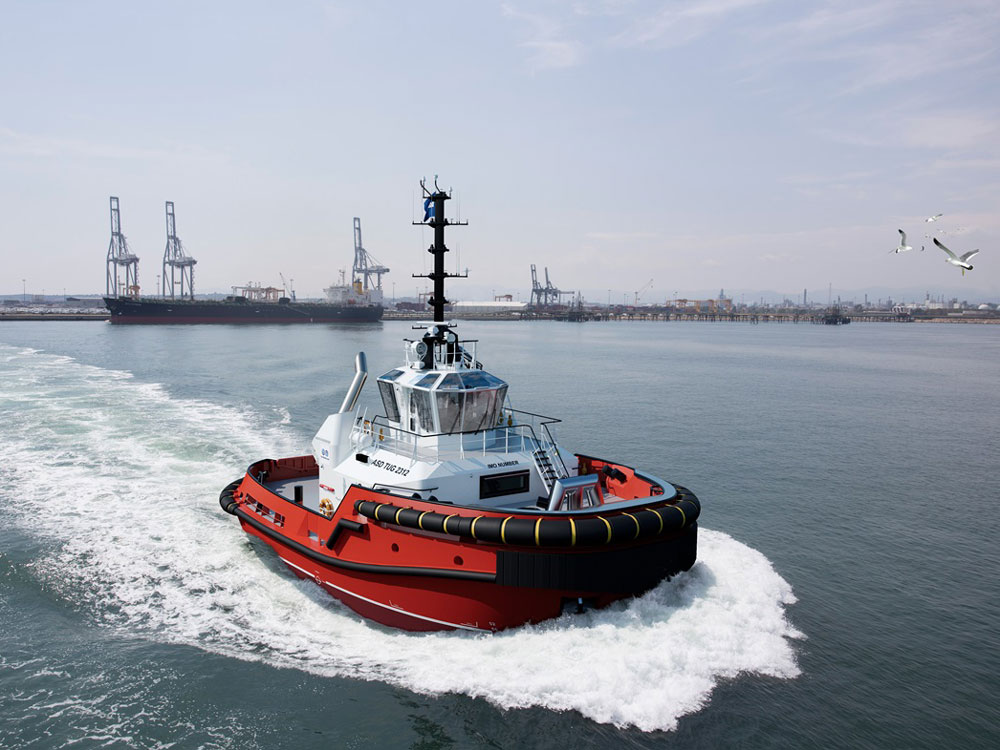
Damen Shipyards Group is to construct an ASD Tug 2312 unit for Port Marlborough New Zealand (PMNZ), which will use the newbuild to provide towage services at Picton Harbour, where approximately 3,000 vessels call annually. The tug, to be named Kaiaua, will work alongside an existing ASD Tug 2111 type, Kaiana, which Damen delivered to PMNZ in 2024.

The ASD Tug 2312 type features a length overall of 22.8m, a breadth overall of 12.03m, a depth of 4.4m and a draught of 5.6m. This model also has a bollard pull capability of 70tonnes ahead and 65tonnes astern, and can achieve a speed of 12.4knots, utilising twin Caterpillar 3512C engines (rated a combined 3,804bkW) and Kongsberg Maritime US 205S FP azimuthing thrusters.  

Part of Damen’s ‘Compact Tugs’ series, the class is arranged for 360° visibility from the wheelhouse and clutter-free decks. Kaiaua will also be equipped with a single winch for both fore and aft operations, installed in the deckhouse to protect it from the elements.

Damen has outfitted the vessel with its own selective catalytic reduction (SCR) system, the Marine NOx Reduction System, which, it says, can reduce NOx emissions by up to 80%, enabling compliance with IMO Tier III requirements. Damen adds: “Although the regulations do not yet apply in New Zealand, PMNZ has committed to providing a more sustainable operation.” PMNZ CEO Rhys Welbourn comments: “This customer-led investment strengthens our ability to respond quickly, assist effectively and support shipping partners making use of the deepest berth in New Zealand. The upgrade to IMO Tier III engines also reinforces our commitment to lowering emissions and operating responsibly.”

Metal Shark fireboat to boost safety in Tampa Bay

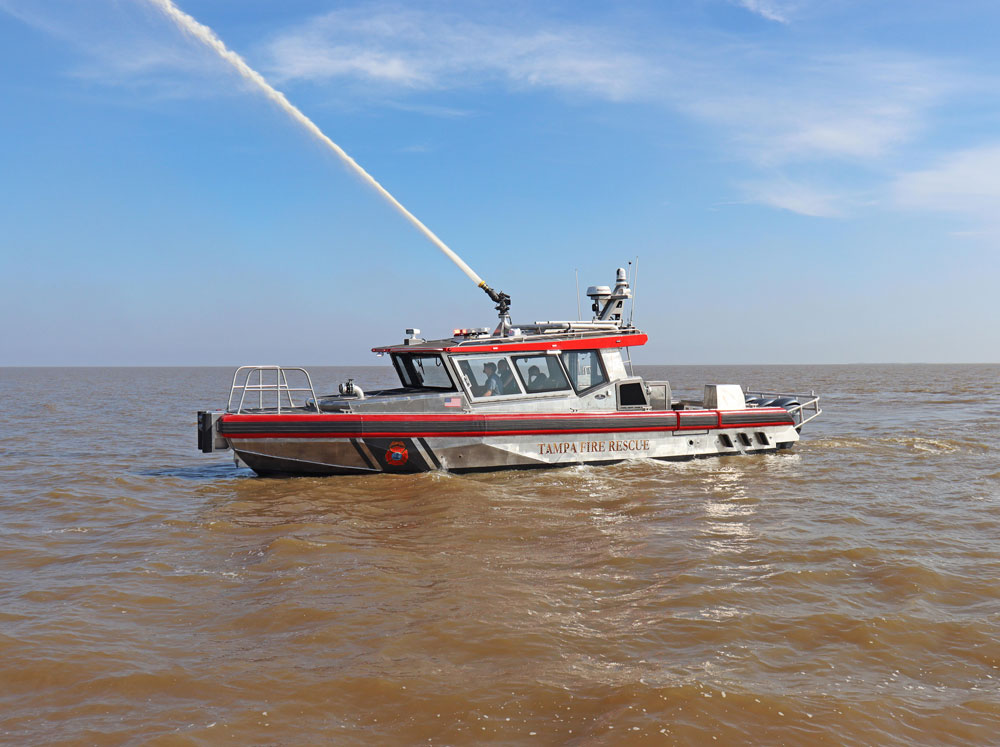
Tampa Fire Rescue, Florida has taken delivery of a monohull fireboat, designed and built by Metal Shark of Louisiana. The newbuild is the first of two sisters for Tampa Fire Rescue, with the second vessel due for delivery in 2026.

Both boats are of Metal Shark’s 38 Defiant NXT class, which features a length of 12.2m, a 3.66m beam and a hull, deck and superstructure built from corrosion-resistant, welded 5086 aluminium-magnesium alloy plates. Each boat is powered by triple Yamaha outboards, offering a combined output of just over 670kW, and incorporates Yamaha’s HelmMaster controls and joystick operability, for enhanced manoeuvrability in tight spots. The latter was deemed crucial as the boat will be navigating “all waters of Tampa Bay, from downtown Tampa to the barrier island of Egmont Key”, Metal Shark explains. The fireboat will also undertake search and rescue missions across this expanse.

Onboard features include the builder’s NXT emergency medical services (EMS) response cabin, which houses three shock-mitigating crew seats, supplied by SHOXS, plus an EMS bench, firefighting control stations and diver/responder gear storage space. The boat has also been equipped with a chemical, biological, radiological, nuclear and high-yield explosive (CBRNE) detection system, provided by Honeywell, and a cabin filtration and pressurisation package from HDT Global.
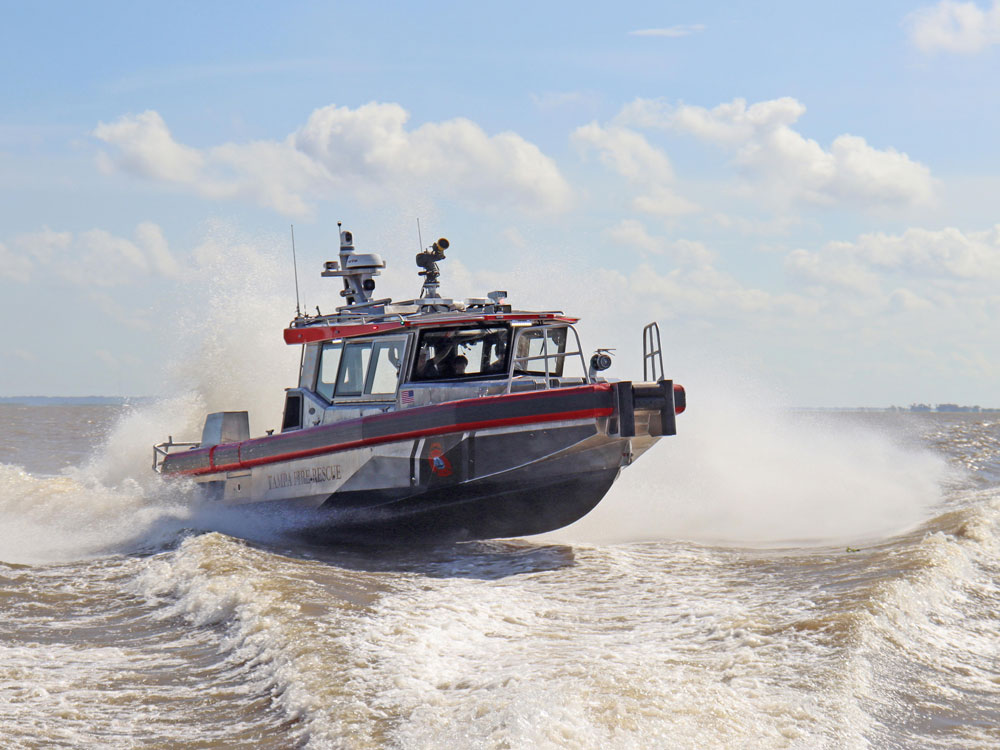
The boat is powered by triple Yamaha outboards, offering a combined output of just over 670kW

The boat also features: a urethane-covered, closed-cell foam collar; a dive/rescue ladder; full-height, hinged dive doors, port and starboard; a FLIR thermal imaging system; and storage space for self-contained breathing apparatus (SCBA) and dive tanks. Additionally, the boat has been created with non-skid walkways with low-level lighting, for night-time operations.

The boat utilises a Darley fire pump, drawing from a fully flooded sea chest, delivering 5,678litres per minute via piping and electronically controlled valves to a remote-operated monitor. Metal Shark says: “This configuration enables long-range throw for ship-to-ship and ship-to-shore operations.” The boat also features dual 2.5” handline discharges, a 5” Storz hydrant discharge (for supplying land-based apparatus) and a 150litre quick-fill foam injection system for aqueous film-forming foam (AFFF)-based fire suppression.

Metal Shark adds that it has delivered new fireboats to “over a dozen fire departments” across the US in the space of 18 months.

'Carbon Destroyer 1' launched as 'virtual CO2 pipeline'

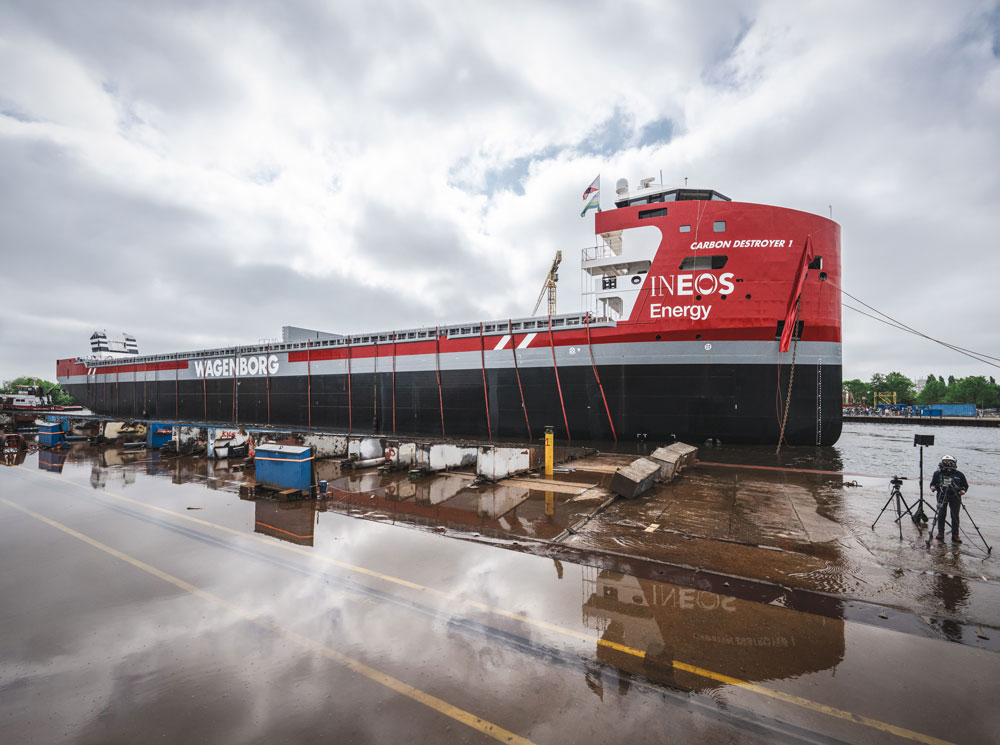
Dutch shipyard Royal Niestern Sander has launched Carbon Destroyer 1, the first CO2 carrier to be built in Europe. The vessel is a key part of the Project Greensand carbon capture and storage project in Denmark and was described by Sir Jim Ratcliffe, chairman of global petrochemicals company INEOS, as “an important next step for carbon capture and storage in Europe…demonstrating that carbon storage is commercially viable”.

Carbon Destroyer 1 is based on Wagenborg’s EasyMax design and has been specially adapted for handling CO2 under pressure and at low temperatures. The EasyMax concept is a multipurpose vessel with a cargo capacity of 14,000tonnes, jointly developed by Royal Wagenborg and Royal Niestern Sander.

Through Project Greensand, Denmark is positioning itself as a hub for CO2 storage in Europe. Carbon Destroyer 1’s role will be to connect CO2 emitters with permanent, commercial-scale offshore CO2 storage. The vessel will transport captured CO2 from across Europe, creating a ‘virtual pipeline’ between the point of capture and permanent storage deep beneath the seabed in the North Sea. The carrier will sail regular routes from Port Esbjerg to the Nini West platform, where the CO2 will be injected for safe and permanent storage to the Nini reservoir, approximately 1,800m beneath the seabed in geological formations that have contained hydrocarbons for millions of years.

The vessel’s launch follows a series of major developments in the Greensand project. In December 2024, INEOS and its partners Harbour Energy and Nordsøfonden took a final investment decision to move ahead with full-scale CO2 storage operations in the Nini Field. The project’s initial phase targets the permanent storage of 400,000tonnes of CO2 annually, with the potential to scale up to 8 million tonnes per year by 2030. The vessel is expected to be fully operational by the end of 2025 or early 2026, when Project Greensand is due to begin permanent commercial scale CO2 storage operations.

At the Port of Esbjerg in Denmark, construction is currently underway on a new CO2 terminal, which will serve as the onshore hub for receiving, storing, and loading liquefied CO2 onto the vessel. Once established, the terminal will include six large storage tanks and essential infrastructure to support continuous and scalable CO2 transport to the offshore storage site.

New firefighter signs up for duty in Singapore

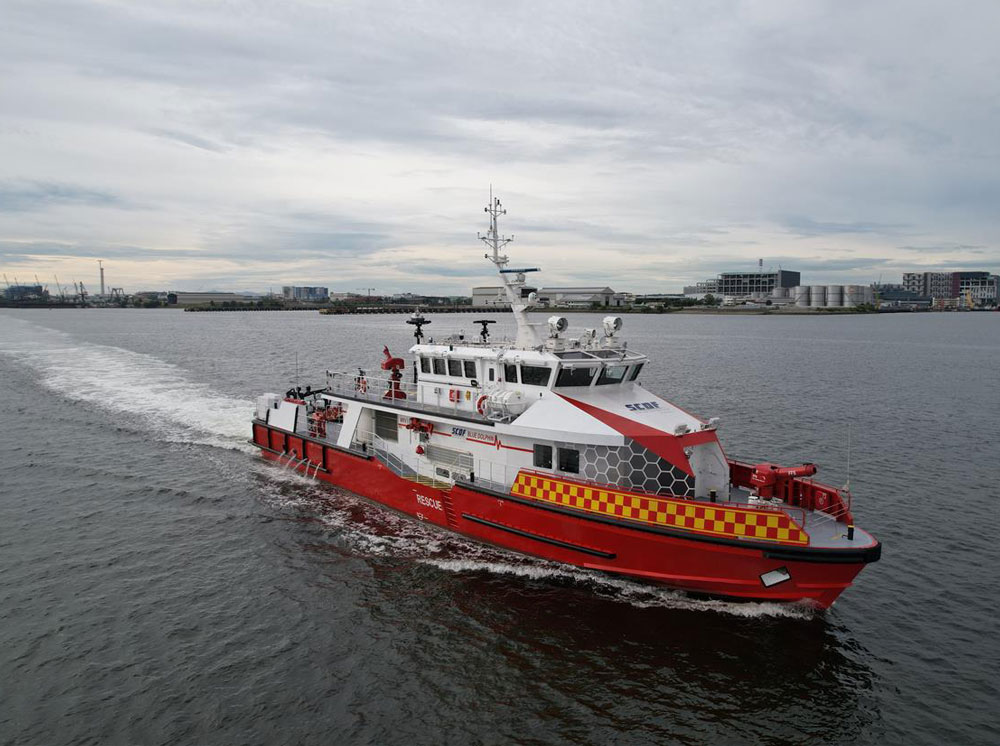
Naval architect and designer BMT and Singapore-based boatbuilder Penguin Shipyard International have delivered a fire and rescue vessel to the Singapore Civil Defence Force (SCDF). The Blue Dolphin MFV-R (standing for ‘multi-role fire vessels – rescue’) is the first of two 38m sisters for the SCDF, each featuring an aluminium monohull and an external firefighting system comprising three fire monitors and three pumps, capable of delivering a combined flow rate of 3,600m3 per hour.  

Described as an evolution of the Red Dolphin MFV-R, which BMT and Penguin produced for the SCDF in 2019, the new vessel has 12,000litres of firefighting foam capacity. BMT comments: “This is further supported by a self-protection water curtain, giving the vessel a fully redundant and highly capable firefighting configuration that exceeds standard FiFi Class 1 requirements.”

The vessel also houses advanced chemical, biological and radiological (CBR) protection systems, plus a decontamination room, a first aid station and a rescue lounge for up to 30 survivors and eight firefighters. Infrared sensors enable the detection and classification of chemical warfare agents and toxic industrial chemicals at a range of up to 5km, BMT adds.  

The Blue Dolphin MFV-R can comfortably sprint past the 30knot mark, and comes with biofuel-compatible engines and solar panel charging systems. The vessel also stores a high-speed RIB on board, which can be scrambled for search and rescue operations close to shore or in restricted waters. The ship is also equipped with a virtual anchoring system, designed to reduce the crew’s workload during station-keeping operations.  

The first Blue Dolphin MFV-R was delivered to the SCDF at a commissioning ceremony hosted at the Republic of Singapore Yacht Club, and the second sister is earmarked for delivery to the SCDF in 2027.

Ignored: the silent tide of suicide at sea

Maritime healthcare provider VIKAND has cited disturbing statistics from Gard’s 2025 Crew Claims Report to raise awareness of the importance of safeguarding seafarer mental health.

The Gard stats – based on 2024 claims data and feedback from more than 6,000 seafarers – indicate that, between 2019-2023, 11% of all seafarer deaths were due to suicide, surpassing the number of deaths caused by onboard injuries.

“Suicide at sea is no longer the elephant in the room – it’s a harsh reality we can no longer ignore,” comments Ronald Spithout, MD of OneHealth by VIKAND. “The silence, the stigma and the systemic underreporting must end…together, we need to ensure a more structural approach and support for seafarers before more lives are lost.”

VIKAND also draws attention to research by Yale University, conducted in 2020 for the ITF Seafarers’ Trust, which found that 20% of surveyed crew members had experienced suicidal thoughts. VIKAND says: “Unique pressures of life at sea, including long isolation, communication challenges and cultural taboos, make seafarers especially vulnerable.

“Most suicides occurred among crew members under age 41, with officers disproportionately affected. Compensation exclusions for suicide further compound the trauma for grieving families.“

VIKAND’s statement includes the case of two Filipino crew members, both described by their colleagues as “outgoing, engaged and sociable” team players, who nonetheless took their own lives – one by hanging, the other by jumping overboard – following family and relationship problems, exacerbated by their isolation at sea. “Neither had a known mental health history or showed visible warning signs,” VIKAND writes. “In each case, psychological support and crew training were implemented – but only after the tragic events.“

The group also cites the case of a 28-year-old doctor who committed suicide in her cabin following a break-up: a tragedy that drove one of her colleagues to drink, leading to his dismissal “without receiving any follow-up mental health care or emotional support”, VIKAND notes.
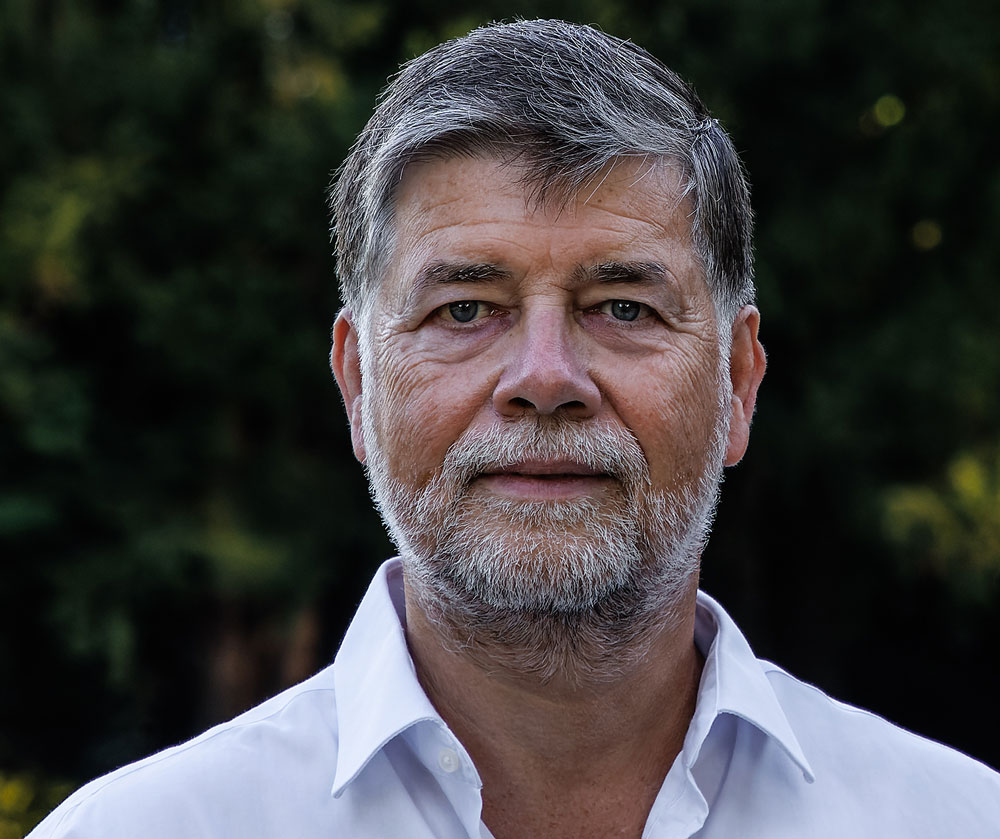
Ronald Spithout, MD, OneHealth by VIKAND: "The silence, the stigma and the systemic underreporting must end"

VIKAND is now urging maritime industry leaders to improve reporting standards, step up mental health support services and push for a “cultural transformation” to remove the stigma about mental health issues, “so seafarers feel able to ask for help without fear of judgement or shame”.

This would involve greater use of pre-employment psychological screening, to identify vulnerabilities before crew members take to sea, and targeted training for officers and crew, helping them to spot early signs of distress among their colleagues and to react accordingly. “Fragmented, reactive approaches to mental health are no longer sufficient,” the group warns. “More effort must go into receiving even the faintest early warning signals.”

VIKAND has rolled out an AI-backed digital screening tool, Crew Wellness Pulse Check, which enables seafarers to anonymously complete surveys related to their mental health. This data can then be used to build up a bigger picture of the problem and to detect patterns and trends. VIKAND also provides 24/7 helplines for immediate support. “This isn’t about checking a box – it’s about proactively trying to save lives,” says Spithout. “Together, we can build a maritime culture where every seafarer feels seen, supported and safe.”
A new 'Guardian' emerges - in CTV form

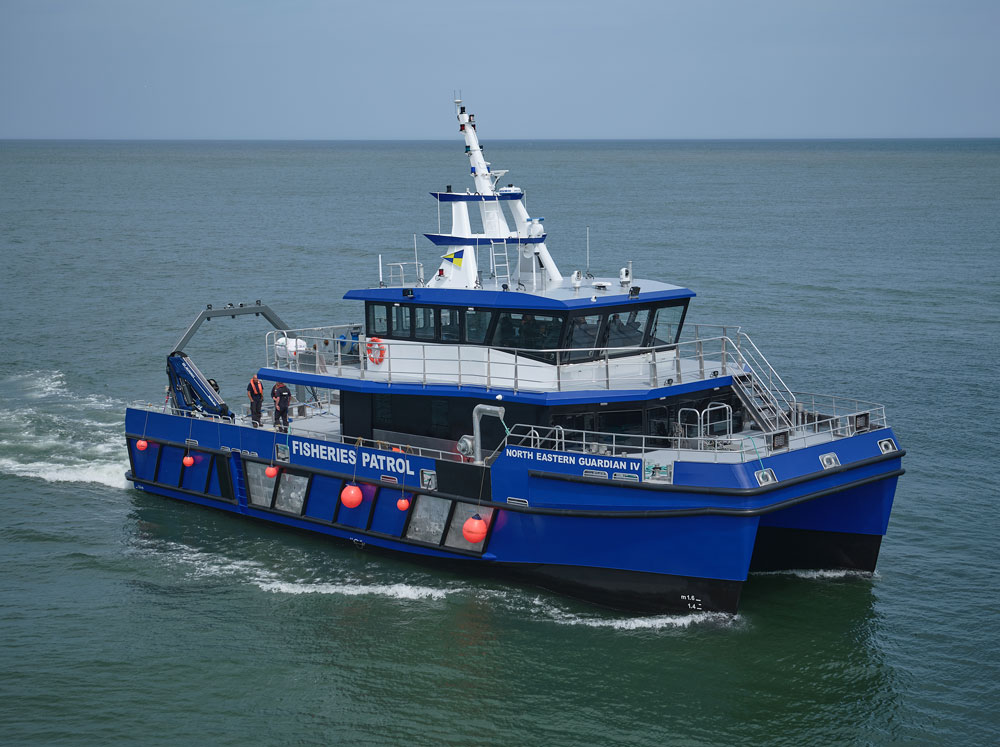
The new North Eastern Guardian IV had to be extremely capable and based on a proven, sub-24m design. So, what better architecture than an established crew transfer vessel (CTV)?

In fact, the North Eastern Inshore Fisheries and Conservation Authority (NEIFCA) had been planning a replacement for its forerunner, North Eastern Guardian III, for some years. As Chartwell Marine technical director Chris O’Neill relates, a trip out on a CTV sold NEIFCA on the platform’s suitability. Chartwell’s flagship CTV platform has a length of 24.4m and a beam of 8.87m. “It’s an extremely adaptable design,” says O’Neill. Despite this, there’s a big difference between wind farm support and fishery operations.

Further, while the hull spaces and working areas are designed to hold quite a bit of equipment, it was only when Chartwell got down to the details that it became clear how much the operating team wanted to pack in. The nub of the issue, O’Neill explains, was the need to fulfil two different functions: on one side there is research; on the other, fishery patrols. So, while there may be substantial survey work and data collection, there’s also comprehensive regulation enforcement: that requires radar and plotting systems to monitor fishing vessels around prohibited areas, along with the ability to move quickly. “We tried to keep the hull as similar as possible with regard to resistance and performance,” says O’Neill. “However, above deck the design changed quite significantly.”

One of NEIFCA’s main goals was to gain more load capacity. While the previous North Eastern Guardian III is a capable vessel, it’s a monohull with a much smaller rear deck tucked in behind the deckhouse. But taking a CTV platform, which normally operates from the bow, and creating a much larger aft deck meant relocating the superstructure, bringing it forward. While that involved “quite a lot of work on weight distribution”, says O’Neill, the result has been worth it: it’s opened up an 80m2 working space at the rear.

Despite this, North Eastern Guardian IV’s deckhouse has also remained sizeable, the floor area measuring 70m2. Its layout embraces a pantry, mess area, skipper and crew cabin, changing room, wet room, storage space, shower and comfort facilities, as well as access to the 35m2 wheelhouse above. Here, along with the skipper’s console and associated equipment, are both wing and aft operating stations, along with crew seats plus a sofa and table area.


For the full article, see the July 2025 issue of The Naval Architect

Sir Thomas Slade: Nelson's naval architect

At the Battle of Trafalgar, nearly a quarter of Nelson’s fleet, bearing nearly a third of the fleet’s guns, was designed by Sir Thomas Slade (1703/4-1771), who is buried in Ipswich, Suffolk, writes Peter Turner.

Thomas Slade was born into a well-established family of Ipswich and Harwich shipbuilders, while his uncle, Benjamin Slade, was master shipwright at Plymouth Dockyard. He probably began his apprenticeship at Deptford Yard, on the River Thames, in 1718. He became the naval overseer to the building of fourth-rate Harwich in Harwich, in 1742, and two years later surveyed Sandwich harbour and helped the planning of improvements to Sheerness, after which he was appointed assistant master shipwright at Woolwich. 

When Benjamin was ordered by Admiral Anson, First Lord of the Admiralty, to examine the lines of some French prizes, he commissioned Thomas to make plans of them. As a result, Thomas became the protégé of Anson and was moved in turn from Plymouth, where he had replaced his deceased uncle, to Woolwich, Chatham and finally to Deptford in 1753, from where he continued to advise Anson. 

In 1747, Thomas Slade married Hannah Moore of Ipswich (d. 1763) and they had one son, Thomas Moore Slade. When, in 1755, the incumbent surveyor of the navy, Sir Thomas Allin, was taken ill, the Admiralty appointed Thomas Slade joint surveyor with William Bately. By this time, Thomas Slade was already designing ships and his early designs included the first British-designed ‘74’s: a new type that became the staple of the British fleet until after the Napoleonic Wars ended in 1815. These were an evolution of previous British ships built to compete with the new French vessels of the same number of guns. There were at least forty-six 74s built to his designs.

Slade started designing smaller ships in 1756 and developed the true frigate, which still comprised two decks but with an unarmed lower deck, and with guns on the upper deck of a larger size than those on previous ships of this rating. 

It was Slade who designed HMS Asia, the first true 64-gun ship. As a result, the Royal Navy ordered no further 60-gun ships but instead commissioned more 64s. Because these incorporated alterations learned from trials with Asia, subsequent ships Slade designed were bigger and would become the Ardent class of 64-gun ships of the line.  

The first HMS Ardent was ordered in 1761, and six more would built over the following two decades. These included HMS Indefatigable, which was converted to a 44-gun razee frigate before being launched from Buckler’s Hard in 1784. A razee frigate is one that has had the upper gun deck removed, based on the French word rasé. This was because time had shown that while these were excellent ships, they were too small for use in the line of battle and so were converted to successful frigates.  

Indefatigable had a series of illustrious commanders, including Captain Edward Pellew’s action with the much larger French 74-gun Droits de l’Homme and Commodore Graham Moore’s capture of the Spanish treasure fleet in 1804, among many other actions. Both captains would rise later to admiral. Indefatigable would overall be credited with a part in 92 captures of enemy vessels.  

Two more of these ships were involved in the career of Nelson: HMS Raissonable and HMS AgamemnonRaissonable was built at Chatham and was Nelson’s first ship, although she only operated in the Medway at that point. Agamemnon was also built at Buckler’s Hard and was Nelson’s favourite ship, and where he spent most of his time as a captain. Nelson was on board Agamemnon from January 1793 to June 1796 and lost his eye while in command.  

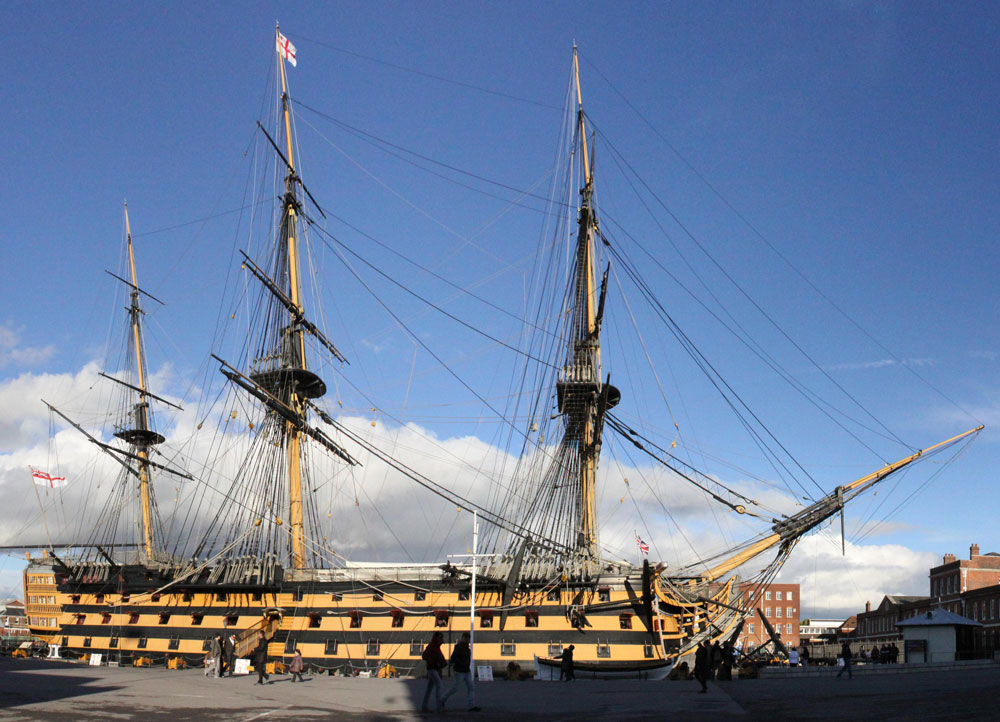
In 1756, Slade began work on the design of the ship most associated with Nelson. It was to be the only first rate that he designed and which would become HMS Victory (100 guns). Victory was not launched until 1765 but, despite having exceptionally good sailing qualities, she did not see service during Slade’s life.  

Slade was a prolific ship designer, for which he was knighted in 1768, but he died in Bath in 1771. His designs continued to be used until well after his death, with Victory being Slade’s greatest memorial, as she is still preserved to this day, at Portsmouth Historic Dockyard. However, his designs of many of 74-, 64-, 32- and 28-gun ships were also very successful.

Peter Turner is the editor of The 1805 Club’s magazine ‘The Kedge Anchor’. The 1805 Club is a society, open to all, which was formed to preserve and care for the memorials and graves of those associated with the sailing state navy of the Georgian era. In recent years it has established the Trafalgar Way, which runs from Falmouth in Cornwall to the Admiralty in central London and follows the route of Lieutenant Lapenotiere’s journey to deliver news of the victory. For more info, see the July 2025 issue of The Naval Architect.

UK USV developers fighting to thrive

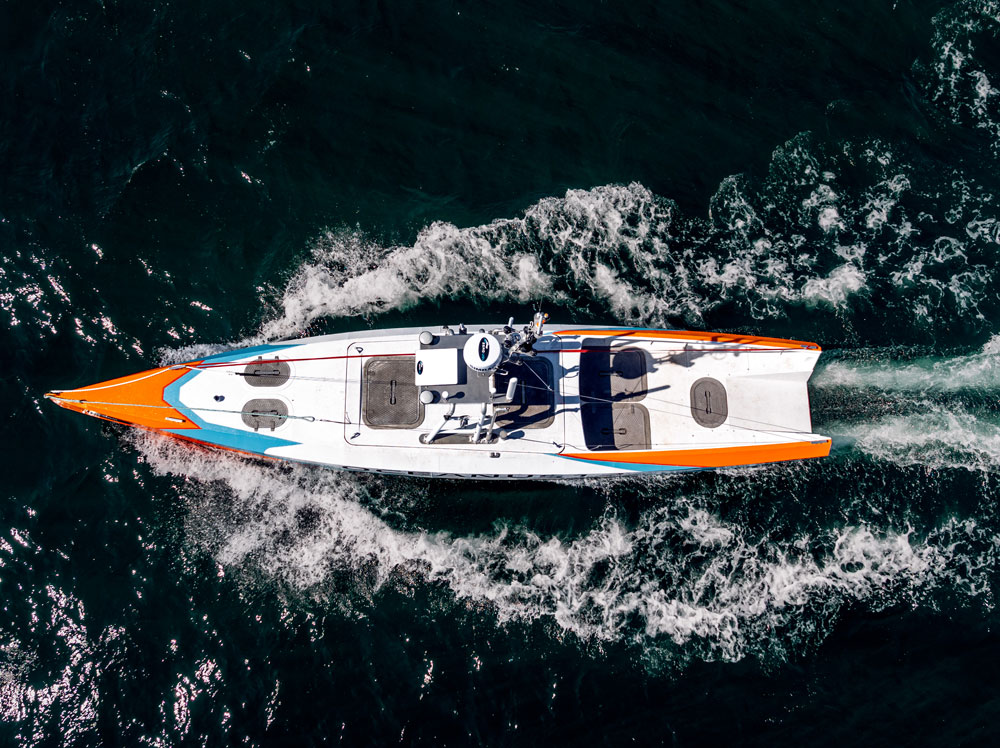
The UK is poised to lead in uncrewed surface vessel (USV) development, backed by strong technical expertise and government initiatives like the Ministry of Defence’s NavyX programme. However, regulatory hurdles are stifling progress, says Matthew Ratsey, MD of Plymouth-based Zero USV, one of two key UK USV developers who spoke to The Naval Architect for our July issue feature on uncrewed vessels.

The Maritime & Coastguard Agency (MCA) has been criticised for its lack of clarity and slow progress, set against the pace of development established by the USV manufacturers. Frustrated, Ratsey emphasises the transformative potential of USVs, particularly in swarm operations for tasks like offshore wind surveys and fisheries monitoring, but stresses that without a clear regulatory framework, the UK risks losing its edge in this innovative sector to more supportive markets abroad.

His views are echoed by James Williams, CEO of Cornwall-based Uncrewed Survey Solutions (USS). In fact, the lack of regulatory clarity led USS to register its new vessels under the San Marino flag for overseas operations, as the UK’s framework lacks proportionality for smaller USVs, applying the same rules to 1m and 24m vessels alike. The MCA’s recent marine guidance notes (MGN 702 and 705) offer exemptions for USVs under 4.5m, but these measures still limit the operational capacity of USS’ USVs by requiring the removal of payload modules to comply, reducing functionality. Don’t miss the July 2025 issue of The Naval Architect where Ratsey and Williams outline the extent of the problem and what needs to be done to fix it.

Bolidt solutions high on the decking order for RCI

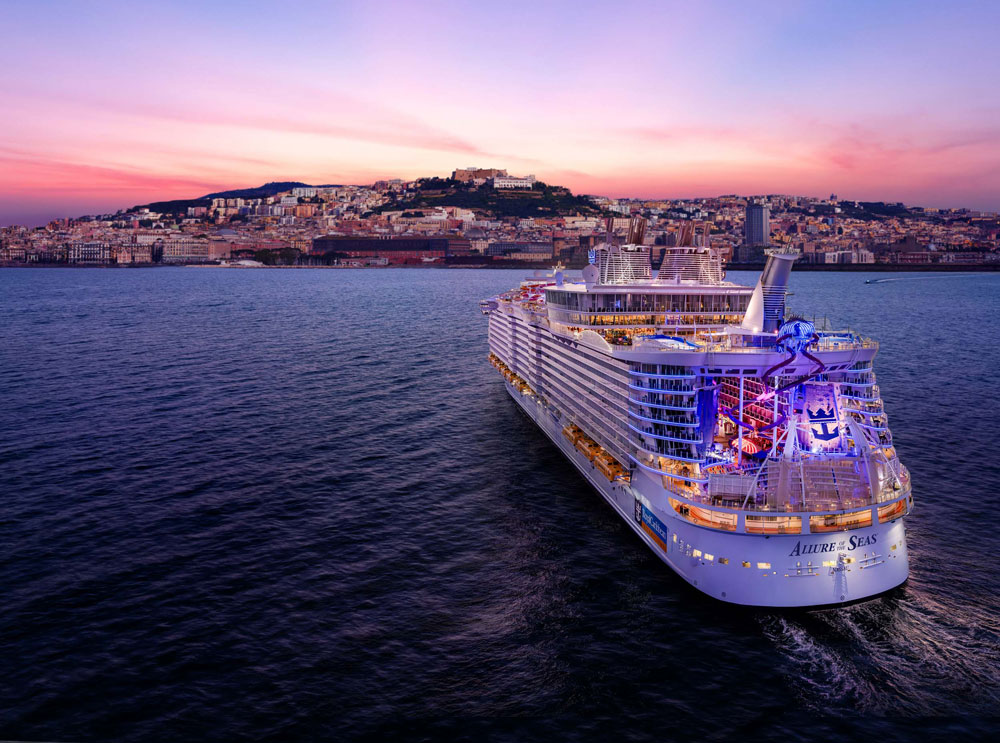
Dutch maritime decking specialist Bolidt recently completed its largest ever retrofit project, installing around 18,000m2 of decking on the Royal Caribbean International (RCI) cruise vessel Allure of the Seas. The sheer scale of the project presented a number of challenges, which the company worked with the client, the shipyard – Navantia Cadiz – and other subcontractors to overcome.

Delivered in 2010, the 362m-long, 5,500-pax-capacity Allure of the Seas was scheduled for a major refit just before COVID struck. However, this meant it had to be postponed by RCI, which last year decided to reactivate the project, to modernise the vessel and keep it competitive with new-generation ships now entering service.

Consequently, having been contracted by RCI to carry out the decking elements of the refit, Bolidt started the necessary preparatory work in July 2024. Gerben Smit, head of operations, global maritime business, says: “This was by some way the biggest project we had undertaken to date, surpassing our previous most extensive contract in the maritime sector, which involved a refit of RCI’s Adventure of the Seas. The lengthy preparation period…enabled us to build up a close understanding with not only the client and shipyard, but other subcontractors that were going to be working in the same spaces as us, to ensure the job went smoothly.”

Bolidt was contracted to supply a range of different products, including Bolideck Future Teak, Select Soft and Hard Soft, in 34 different areas on board, both indoors and outdoors, across decks 5 to 17. On the 4,000m2 pool deck, Bolidt installed its lightweight and hard-wearing Bolideck Future Teak, resurfacing existing installations, and fitted a new kids’ pool area with Bolideck Select in various designs. It also repaired and resanded the 1,950m2 jogging track, while installing Future Teak and Select Soft on 115 balconies spanning 1,900m2, and soundproofing a new 800m2 extension to the solarium on Deck 15.

To ensure that the work could be completed within the required time window, around 120 Future Teak-manufactured items were prefabricated in the Netherlands, in partnership with local resin systems specialist Boteka. In total, over 60 truckloads of components were moved between the Netherlands and Spain for this one project.

The preparation period also enabled the various stakeholders to iron out some potential issues well before the start date. One of the most significant was the fact that the 18,000m2 of new Bolidt materials would have added a significant amount of weight to the vessel. Consequently, Bolidt and RCI were able to plan for Bolidt technicians to remove around 10mm of the existing surfaces and underlay prior to installation of the new materials, to achieve a broad weight balance between the pre- and post-refit situation.

At the project’s peak, Bolidt had around 150 skilled technicians on Allure of the Seas and managing this team required intense support from Bolidt’s Netherlands-based operations team, who supervised all the necessary hotel, flight and other bookings to ensure the technicians could focus on the task in hand.

Smit adds: “The biggest challenge was the sheer scale of the project, which tested our capabilities in many different aspects, and required not only extensive pre-project preparation but ongoing liaison during the refit with all the other contractors. But, while you can plan for most things, you can’t plan for the weather, and the project was negatively impacted by a lengthy period of rain while the ship was in drydock. This required us to become even more agile and flexible, and to intensify cooperation with the other contractors, to ensure the project did not overrun.”

Allure of the Seas is one of nine RCI ships Bolidt has refurbished since mid-2024. However, the company is also involved in a number of newbuilding projects, one of the most notable being work on Accor’s Orient Express Corinthian, a 220m–long sailing yacht under construction at Chantiers de l’Atlantique, France. This will be the launch vessel for a new product, Bolideck Future Teak Signature Premium, that Bolidt has developed to provide a lightweight and hard–wearing synthetic material that is as close as possible in look and feel to real teak. 


For the full story, see the July 2025 issue of The Naval Architect