40 under 40

Take 10 seconds to nominate a colleague, mentee or friend for our Forbes-style list. Must be under the age of 40 in 2026. Open to all maritime professions associated with naval architecture. See eligibility criteria. [hyperlinked].  
 

Nominate with LinkedIn profile 


JOIN TO ADVANCE

Renowned for the technical excellence of our events, publications and learning, we offer career pathways for naval architects and 16 associated professions [hyperlink to 16 professions].

join to influence

We cover everything from super yachts and green propulsion to warship resilience. Network 1-2-1 with top talent at our events or influence the maritime industry by joining one of our comittees.  

JOIN TO INNOVATE

We promote the interdisciplinary conversation at the heart of maritime innovation. Speak at our events, publish in our journals or simply join the discussion forums on our website.  

Not quite ready to join yet? 


?? HOW?? FILL IN EMAIL HERE AND SIGN UP WITH 1 CLICK 

DISCOVER

View All

>

SPONSORED: Fincantieri shapes the future of Cruise Navigation with Vard Electro's SeaQ Bridge

Detail Link
>

Endurance boost for new long-range-capable Oceanus12

Detail Link
>

CORE POWER CEO hints at roadmap to nuclear energy adoption

Detail Link
>

Sanmar launches first tugboat for Greece

Detail Link
>

UK consortium unveils floating wind installation vessel concept

Detail Link
>

Repair round-up: yards form green alliance

Detail Link
>

Sea Dart takes on multipurpose underwater roles

Detail Link
>

Keeping an AI eye on safe speeds

Detail Link
>

'Neoliner Origin' goes back to the future (of sailing)

Detail Link
>

Tech-friendly Abu Dhabi becomes 'ROC City'

Detail Link


???HOW??? what is the best slice to display TESTIMONIALS [LARGE photo + COLOURED BACKGROUND with LARGE quote imposed over it?]

  • Graduate Naval Architect [eg. Aidan Atkinson]

  • Prime Career [eg. Chris Nair]

  • Iconic Status and Giving back to Global Community [eg. Ian Buxton]

 
Global Events Connecting Maritime Leaders


Events


From flagship international conferences to specialist technical seminars, RINA events bring together experts, innovators, and professionals to share knowledge and shape the future of naval architecture.


Explore Upcoming Events
Events

Lorem ipsum dolor sit amet, consectetur adipiscing elit, sed do eiusmod tempor incididunt ut labore et dolore magna aliqua. Ut enim ad minim veniam, quis nostrud exercitation ullamco laboris nisi ut aliquip ex ea commodo consequat. Duis aute irure dolor in reprehenderit in voluptate velit esse cillum dolore eu fugiat nulla pariatur. Excepteur sint occaecat cupidatat non proident, sunt in culpa qui officia deserunt mollit anim id est laborum.

View All

CORPORATE PARTNERS

Using AI to fast-track maritime nuclear licensing
Ship repair and retrofit trends boost Seatrium
SPONSORED: FleetguardFIT™ Reduces Service Cost by 50% for Marine Customer
Alt-fuel adoption on the ascent, DNV notes
Green Marine dives deep with new subsea-focused investment
Fincantieri stacks up cruise build and repair work
New Logistics Support Ship designs from Damen
Call for UK to exploit 'unique' nuclear opportunity
Build it smart: UK yards must tackle AI and robotics skills gap
Heavy-lift muscle for Japanese wind farms
Four more Type 212CD subs for German Navy
Drones partner up for subsea asset checks
"Significant milestone" for homebuilt Indian Navy vessels
New IACS recommendation for shore-to-ship power
Damen repair division invests further in sustainability

HEADING


Lorem ipsum dolor sit amet, consectetur adipiscing elit, sed do eiusmod tempor incididunt ut labore et dolore magna aliqua.


CLICK HERE

HEADING


Lorem ipsum dolor sit amet, consectetur adipiscing elit, sed do eiusmod tempor incididunt ut labore et dolore magna aliqua.


CLICK HERE

Contact Us

Get in touch

Lorem ipsum dolor sit amet, consectetur adipiscing elit. Aliquam aliquam arcu nec dictum cursus. Phasellus porttitor vitae mi vitae interdum. Fusce eu libero et eros pharetra posuere. Class aptent taciti sociosqu ad litora torquent per conubia nostra, per inceptos himenaeos.

Lorem ipsum dolor sit amet, consectetur adipiscing elit, sed do eiusmod tempor incididunt ut labore et dolore magna aliqua. Ut enim ad minim veniam, quis nostrud exercitation ullamco laboris nisi ut aliquip ex ea commodo consequat. Duis aute irure dolor in reprehenderit in voluptate velit esse cillum dolore eu fugiat nulla pariatur. Excepteur sint occaecat cupidatat non proident, sunt in culpa qui officia deserunt mollit anim id est laborum.

The Bundestag and the Federal Government have agreed to exercise an option to procure four more Type 212CD submarines for the German Navy. The contract for the new submarines, which are being acquired by the German Navy and Royal Norwegian Navy under a joint programme, is one of the largest secured by thyssenkrupp Marine Systems.

The deal was initialled by the president of the Bundeswehr Procurement Agency, Annette Lehnigk-Emden, and thyssenkrupp Marine Systems CEO Oliver Burkhard in late December 2024. Germany will now build six Type 212CDs. Norway has also recently signalled its intention to increase the number of submarines it builds under the joint programme from four to six.

Speaking as that deal was confirmed, Burkhard said: “A turning point in history is finally arriving in the maritime sector. We are delighted at the trust that the German government has once again placed in us with the additional order. We are making a decisive contribution to Germany’s response to changing times and strengthening our defence capabilities with this strategically important project between Germany and Norway.”

The Type 212CD submarines will be significantly more capable than the German Navy’s existing Type 212A boats, with enhanced situational awareness, superior networking with allied units and a reduced signature.

In advance of the construction of the submarines, thyssenkrupp Marine Systems has invested more than €250 million at the company’s yard in Kiel, including a new shipbuilding hall. The group has also acquired additional shipyard capacity at the former MV Werften site in Wismar, to be able to build submarines and surface vessels there at the same time.

“Our order books are well-filled and we are strongly positioned nationally and internationally,” said Burkhard, noting that now that the number of Type 212CD submarines on order has been increased, other countries could join the project in the near future. “Our strong position has now become even stronger,” he concluded.

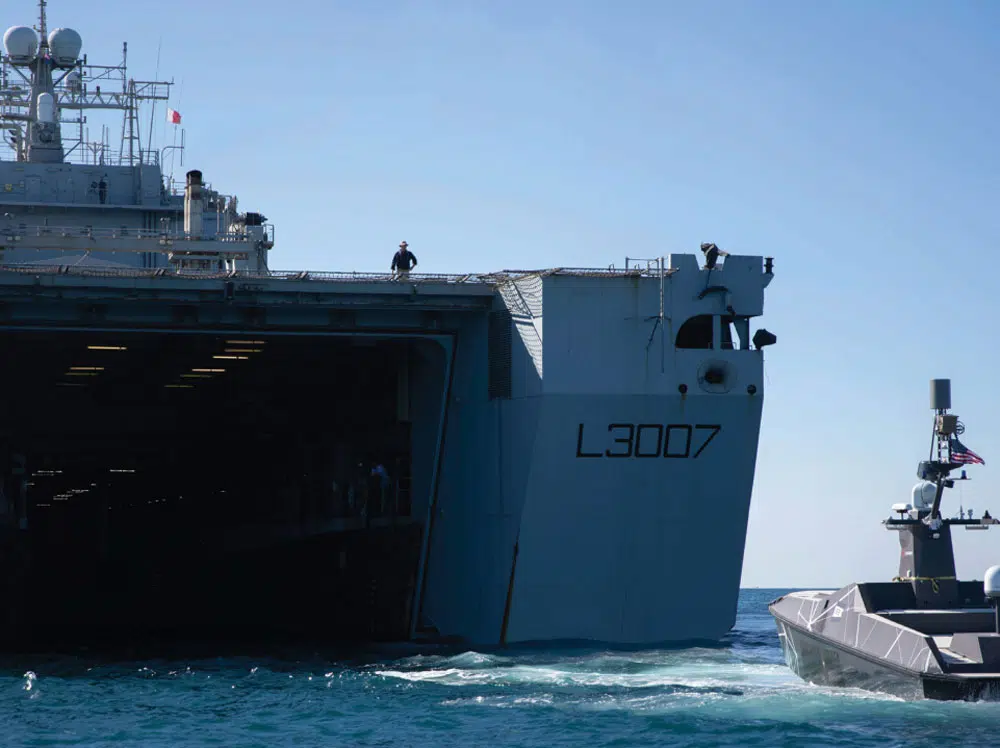
A team-up between boatbuilder/USV manufacturer Tuco Marine and maritime survey tech company EIVA aims to establish an all-in-one autonomous package for subsea asset inspections, matching a Tuco-built ProZero 8m Naval Intelligence USV to EIVA’s ViperFish remotely operated towed vehicle (ROTV).

In practice, the USV would sail to an area of interest, towing and remotely launching the ViperFish. The ViperFish would be equipped with sensors and survey software, and would undertake high-resolution seabed imaging, with area coverage rates of 1.6km2/hr,  while using magnetic signals to monitor subsea assets, such as power cables.

Jonas Pedersen, MD of Tuco Marine, comments: “By combining…our ProZero with EIVA’s ROTV, it’s possible to monitor the conditions of critical subsea infrastructure much more thoroughly and frequently than with conventional set-ups.”

Launched in 2023, the ViperFish measures 3,200mm x 1,300mm x 620mm and is rated for depths descending to 200m. The ROTV is designed for surveys at 2-10knots, and has a reported target positioning accuracy of 1m. EIVA suggests that, when integrated with an USV, the ViperFish can also be used for mine countermeasures, rapid environmental assessment, surveillance and salvage missions.

The commissioning this week of three frontline naval vessels by the Indian Navy marks a “significant milestone in India’s shipbuilding and design capabilities”, according to analytics firm GlobalData.

January 15 saw the entries of INS Surat (163m), the fourth and final unit of the Visakhapatnam class of stealth guided-missile destroyers; INS Nilgiri (149m), the lead ship of the Nilgiri class of stealth guided-missile frigates; and INS Vagsheer (67.5m), the sixth of six Kalvari-class diesel-electric submarines. The vessels were constructed by Mazagon Dock Shipbuilders Limited (MDL), Mumbai.

Rithik Rao, aerospace and defence analyst at GlobalData, writes: “Armed with advanced weaponry such as BrahMos and Barak 8 missiles, both INS Surat and INS Nilgiri provide the Indian Navy with enhanced anti-surface and anti-air warfare capabilities, excelling in both offensive and defensive roles.

“INS Vagsheer excels in a range of operations, including anti-surface and anti-submarine warfare, intelligence gathering and area surveillance. Together, these domestically built platforms demonstrate India’s growing competence in developing cutting-edge naval technologies, thereby strengthening its maritime security and reinforcing its strategic autonomy in defence production.”

Rao adds that India has felt the need to step up its naval defence capabilities due to “the increasing maritime presence” of the Chinese People’s Liberation Army Navy (PLA Navy) in the Indian Ocean Region. “[India] is trying to catch up with its Chinese counterparts in terms of quantity and technology advancements,” Rao says. GlobalData has forecast that India will spend just over US$35 billion on various domestically built naval vessels and subs in the run-up to 2029.

“Shipbuilders such as MDL stand to benefit significantly, leveraging the expertise gained from constructing complex naval platforms,” says Rao. “Such advancements will lay a strong foundation for future collaborations between major domestic defence contractors and many small and medium suppliers in upcoming next-generation submarine and naval vessel construction programmes, ensuring the Indian Navy remains well-equipped to meet evolving challenges in the upcoming decades.”

Speaking at the commissioning ceremony, Indian prime minister Narender Modi commented: “I am happy that our Navy has expanded the ‘Make In India’ campaign to a great extent. In the last 10 years, 33 ships and seven submarines have been inducted into the Indian Navy. Out of these 40 naval vessels, 39 have been built in Indian shipyards.

“Along with increasing the strength of the Indian armed forces, ‘Make In India’ is also opening new doors of economic progress. The shipbuilding ecosystem is an example. Experts also say that the more investment is made in shipbuilding, the more positive impact it has on the economy.”

The International Association of Classification Societies (IACS) has published a new recommendation, titled Rec. 182, to provide a “comprehensive framework” to support the adoption of onshore power supply (OPS) systems.

Rec. 182 was drawn up to provide “detailed guidance for ship designers, builders, operators and owners on integrating OPS systems into both newbuilds and retrofits, while addressing the technical and operational challenges associated with its implementation”, IACS states. The recommendation is intended to complement IMO’s MSC.1/Circ.1675 – Interim Guidelines on the Safe Operation of OPS Service in Port for Ships Engaged on International Voyages, IACS adds.

Subsequently, Rec. 182 outlines aspects such as: ship requirements for OPS; ship-to-shore connection protocols, with an emphasis on safe connection and disconnection; and testing procedures, for both the first connection and periodic check-ups. IACS states: “At the first call at a shore supply point, ships should undergo mandatory tests, including visual inspections, insulation resistance measurements, functional tests of protection devices and integration tests, to ensure proper operation between ship and shore installations.

“If the time between repeated port calls does not exceed 12 months and no modifications have been made, only limited verification tests are required. However, if the interval exceeds 12 months, comprehensive testing as outlined in the document should be conducted.”

Rec. 182 also covers operational safety measures, including the use of suitable PPE, plus ensuring “effective communication” between shipboard crew and shoreside personnel during connection/disconnection procedures. Documentation of OPS operation procedures – which would include circuit diagrams, compatibility assessments and emergency shutdown protocols – is also underscored in the recommendation, as is a pre-connection safety checklist.

IACS says: “The shift towards decarbonisation has placed a spotlight on reducing emissions from seagoing vessels while at ports, where vessels often rely on auxiliary engines that contribute to greenhouse gas [GHG] emissions. OPS, commonly referred to as ‘cold ironing’ or shore-to-ship power, has emerged as a promising solution, allowing vessels to connect to a land-based electrical grid while at berth, enabling their onboard generators to be switched off.” Cold ironing has been credited with significantly cuttting NOx and SOx emissions, plus particulate matter (PM) levels, in port areas, enabling the future development of sustainable ports.

Rec. 182 can be accessed at the IACS website.

Damen Shiprepair Oranjewerf is strengthening its commitment to green ship repair, maintenance, conversion and refit projects with a recent shore power installation. The yard had already installed a shore power unit which was suited to many of its projects. However, with this latest installation, developed by Elma Systems, the availability of clean onshore power, converted to 60Hz, has been widened to cover all types of vessel that call at the yard.

Commercial manager Jeen van der Werf explains: “Previously, we were able to provide shore power at 50Hz. However, we get a lot of offshore, navy and fishing vessels come to the yard for work, and many of these vessels operate on 60Hz.” As a result, he says, the yard often had to hire in a diesel-powered generator; something the company was keen to avoid.

Damen Shiprepair Oranjewerf began discussions with Elma Systems to address this issue. Together, the two companies set about the development of a solution that was more in tune with the yard’s needs, and Elma came up with a rotary convertor, which converts the shore power to the desired 60Hz rating.

The shore power system, which is installed on the yard’s floating dock, can support up to 250kVA. Should more power be required, there is an option to add a battery or secondary power source. The Elma-designed rotary converter is therefore also equipped with a load sharing system.

With this new shore power system now fully operational, Damen Shiprepair Oranjewerf expects to significantly reduce its carbon emissions. As an additional benefit, the wider use of shore power means that the yard no longer has to hire in costly diesel generators, and is, therefore, able to offer its clients a more competitively priced project.

Frequently Asked Questions

Lorem ipsum dolor sit amet, consectetur adipiscing elit, sed do eiusmod tempor incididunt ut labore et dolore magna aliqua. Ut enim ad minim veniam, quis nostrud exercitation ullamco laboris nisi ut aliquip ex ea commodo consequat.

Tab1

Lorem ipsum dolor sit amet, consectetur adipiscing elit, sed do eiusmod tempor incididunt ut labore et dolore magna aliqua. Ut enim ad minim veniam, quis nostrud exercitation ullamco laboris nisi ut aliquip ex ea commodo consequat. Duis aute irure dolor in reprehenderit in voluptate velit esse cillum dolore eu fugiat nulla pariatur. Excepteur sint occaecat cupidatat non proident, sunt in culpa qui officia deserunt mollit anim id est laborum.

Tab2

Lorem ipsum dolor sit amet, consectetur adipiscing elit, sed do eiusmod tempor incididunt ut labore et dolore magna aliqua. Ut enim ad minim veniam, quis nostrud exercitation ullamco laboris nisi ut aliquip ex ea commodo consequat. Duis aute irure dolor in reprehenderit in voluptate velit esse cillum dolore eu fugiat nulla pariatur. Excepteur sint occaecat cupidatat non proident, sunt in culpa qui officia deserunt mollit anim id est laborum.
Frequently Asked Questions

Lorem ipsum dolor sit amet, consectetur adipiscing elit, sed do eiusmod tempor incididunt ut labore et dolore magna aliqua. Ut enim ad minim veniam, quis nostrud exercitation ullamco laboris nisi ut aliquip ex ea commodo consequat.

Tab1

Lorem ipsum dolor sit amet, consectetur adipiscing elit, sed do eiusmod tempor incididunt ut labore et dolore magna aliqua. Ut enim ad minim veniam, quis nostrud exercitation ullamco laboris nisi ut aliquip ex ea commodo consequat. Duis aute irure dolor in reprehenderit in voluptate velit esse cillum dolore eu fugiat nulla pariatur. Excepteur sint occaecat cupidatat non proident, sunt in culpa qui officia deserunt mollit anim id est laborum.
Tab2

Lorem ipsum dolor sit amet, consectetur adipiscing elit, sed do eiusmod tempor incididunt ut labore et dolore magna aliqua. Ut enim ad minim veniam, quis nostrud exercitation ullamco laboris nisi ut aliquip ex ea commodo consequat. Duis aute irure dolor in reprehenderit in voluptate velit esse cillum dolore eu fugiat nulla pariatur. Excepteur sint occaecat cupidatat non proident, sunt in culpa qui officia deserunt mollit anim id est laborum.
Tab3

Lorem ipsum dolor sit amet, consectetur adipiscing elit, sed do eiusmod tempor incididunt ut labore et dolore magna aliqua. Ut enim ad minim veniam, quis nostrud exercitation ullamco laboris nisi ut aliquip ex ea commodo consequat. Duis aute irure dolor in reprehenderit in voluptate velit esse cillum dolore eu fugiat nulla pariatur. Excepteur sint occaecat cupidatat non proident, sunt in culpa qui officia deserunt mollit anim id est laborum.

Tab4

Lorem ipsum dolor sit amet, consectetur adipiscing elit, sed do eiusmod tempor incididunt ut labore et dolore magna aliqua. Ut enim ad minim veniam, quis nostrud exercitation ullamco laboris nisi ut aliquip ex ea commodo consequat. Duis aute irure dolor in reprehenderit in voluptate velit esse cillum dolore eu fugiat nulla pariatur. Excepteur sint occaecat cupidatat non proident, sunt in culpa qui officia deserunt mollit anim id est laborum.

text one

Lorem ipsum dolor sit amet, consectetur adipiscing elit, sed do eiusmod tempor incididunt ut labore et dolore magna aliqua. Ut enim ad minim veniam, quis nostrud exercitation ullamco laboris nisi ut aliquip ex ea commodo consequat. Duis aute irure dolor in reprehenderit in voluptate velit esse cillum dolore eu fugiat nulla pariatur. Excepteur sint occaecat cupidatat non proident, sunt in culpa qui officia deserunt mollit anim id est laborum.

SPONSORED: Fincantieri shapes the future of Cruise Navigation with Vard Electro's SeaQ Bridge

As cruise ships grow in size and complexity, digitalizing onboard systems becomes increasingly critical – not only to improve operational efficiency and safety, but also to enhance the working environment for crews navigating these advanced ships at sea.

With the first delivery of its SeaQ Bridge system aboard the cruise vessel Mein Schiff Relax, built by Fincantieri, the subsidiary Vard Electro introduces a fully digitalized and ergonomically optimized solution that sets a new benchmark in bridge design and shipboard operations within the cruise industry. The group’s highest level of bridge integration is a bridge solution with an extended architecture, utilizing a combination of integrated solutions, combined with touch monitors to gather various systems into one operator station.

The project is the result of a close collaboration between shipowner, shipbuilder, technology supplier, navigational officers and the crew, ensuring a seamless integration of design, construction and system implementation tailored for the needs of a modern cruise vessel.

Type-approved design and custom function testing

The SeaQ Bridge is type-approved by DNV, one of the world’s leading classification societies, ensuring compliance with the highest maritime standards. For each project, a separate test is conducted in collaboration with class and ship owners, ensuring that the system meets specific operational requirements. The process has started to have approval in RINA as well.

Expandable integrated applications

What sets the SeaQ bridge as benchmark is its integration of key shipboard systems, including also third-party solutions, into a centralized human-machine-interface (HMI), operable via touchscreens featuring intuitive apps and drag-and-drop functionality.

This setup allows operators to configure personalized layouts, granting immediate access to critical functions. Importantly, the number and arrangement of screens on the bridge are now determined by customer requirements, rather than system limitations, offering a tailored solution that aligns with specific operational needs.

Designed for scalability, the SeaQ Bridge integrates additional applications – such as intercom directories and alarm management – and supports the development of new functionalities as operational needs evolve, while also allowing existing systems to expand.

Extended integration across the ship

The SeaQ Bridge system extends its advanced capabilities to the Safety Command Centre, featuring a large video wall composed of 55-inch multi-displays, each capable of four-way splits, providing operators with a complete overview of critical systems. Dedicated workstations ensure each operator access to essential controls and information.

This integrated SeaQ approach supports coordinated action and faster decision-making across the ship. The same concept is applicable to the Engine Control Room (ECR). All relevant systems from the traditional ECR are now integrated into a common interface. This redundant solution offers user-driven flexibility without compromising system reliability.

In every aspect, this installation demonstrates how digitalization, collaboration, and smart design can transform cruise ship automation and navigation systems. With Mein Schiff Relax, Vard Electro, TUI Cruises, and Fincantieri have created a solution that sets a new standard for future cruise ships.

Also, SeaQ contributes to Fincantieri’s strategy to evolve from Physical vessel design authority to Digital vessel design authority, strengthening its leadership position in technological innovation applied to shipbuilding and to the whole shipping industry.

Endurance boost for new long-range-capable Oceanus12

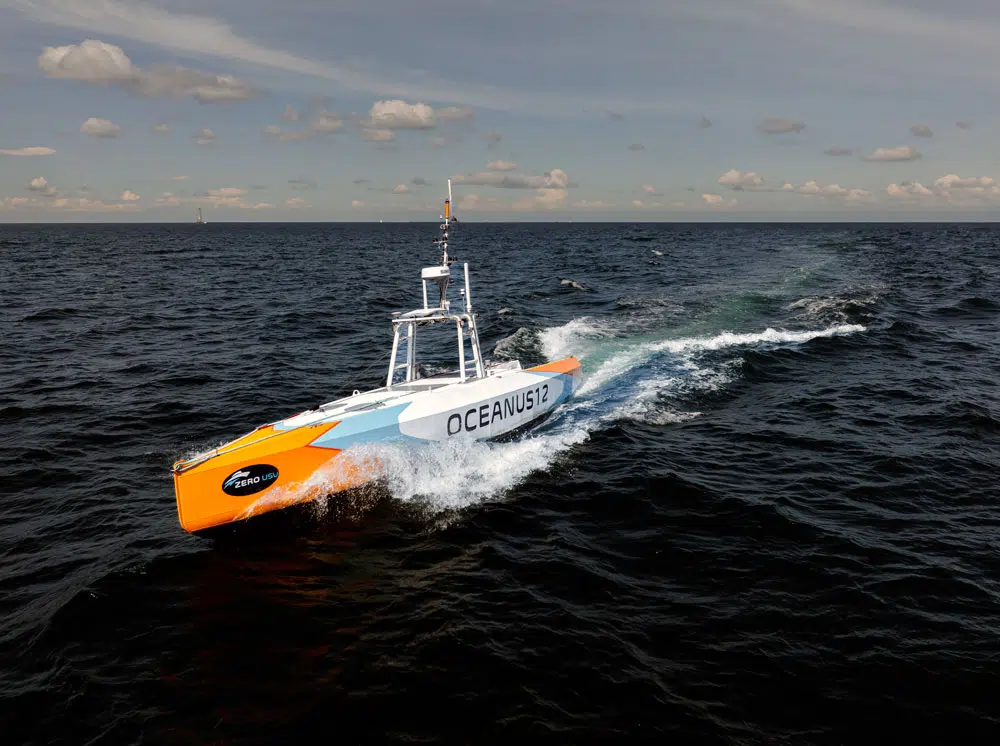
Zero USV has launched the extra-long-range (XLR) version of its Oceanus12 USV, which is intended to ramp up the 20 days/2,500nm endurance of the original Oceanus12 to 60+ days/7,500nm+.

Zero USV says: “[The XLR Oceanus12] is built for missions in remote areas or regions where access to traditional fuelling points is limited, ensuring that operations can continue uninterrupted.” Other modifications include a lengthening of the USV, from 11.55m to 13m, and the drone’s fuel capacity has been increased, from 1,200litres to 4,000litres.

Matthew Ratsey, Zero USV founder and MD, comments: “Uncrewed vessels are a force multiplier. The ability to conduct sustained operations at sea without the need for regular refuelling or crew-related logistics is becoming increasingly crucial as operational pressure on resources and time become more demanding.”

The XLR Oceanus12 features an aluminium hull with a 2.33m beam. The vessel draws 1.76m, displaces 8tonnes and can accommodate a payload of up to 1tonne – enabling it to carry kit such as Marine AI’s GuardianAI suite, plus an autonomous sensor suite featuring an HD radar from Navtech. Powered by a hybrid diesel-electric powertrain, the USV has a cruising speed of 6knots and a sprint speed of 10knots, depending on payload.

CORE POWER CEO hints at roadmap to nuclear energy adoption

The Naval Architect recently caught up with Mikal Bøe, CEO of CORE POWER, for an exclusive, in-depth interview focusing on the potential adoption of nuclear power within the commercial shipping sector.

Since its formation in 2018, CORE POWER has pushed the development and deployment of advanced nuclear energy technologies, specifically modular molten salt reactors (MSRs) and floating nuclear power plants (FNPPs).

“To save fuel and reduce emissions, the global shipping fleet is sailing at its slowest average speed since the launch of the first diesel engine,” Boe told The Naval Architect. “The fleet is becoming less competitive and, with the increased cost of emissions compliance, it will also become more expensive to run.

“Nuclear-powered ships are not constrained by fuel consumption or emissions concerns; they emit nothing and can operate at their design speed without refuelling, enabling faster transoceanic voyages with minimal downtime. Nuclear-powered ships offer a host of additional benefits, from reverse cold ironing to creating new career opportunities for the next generation of marine engineers and ship’s crews.

“The market opportunity for nuclear-powered ships is nearly US$3 trillion, as the global fleet ages and conventionally powered vessels are replaced by nuclear-powered ships to meet emission-reduction targets of 70% by 2040.”

In the interview, Bøe also addressed areas such as international regulations and insurance, waste disposal and best end-of-lifecycle practice, and especially public attitudes towards nuclear power.

Bøe is resolute in his belief that “fearlessly using nuclear technology is essential to combatting the real dangers we face, including water, food and energy shortages, and maintaining social stability”. Regarding nuclear energy’s relative pariah status compared to other alt-fuels, he added: “The historical record should be re-examined…an important question is how society has persisted with such a gross misperception for 70 years.

“The work to educate the public about the real effects of nuclear energy is not ours alone. We therefore strive to work with organisations and groups that are dedicated to scientific truth and good scientific communication.”

Sanmar launches first tugboat for Greece

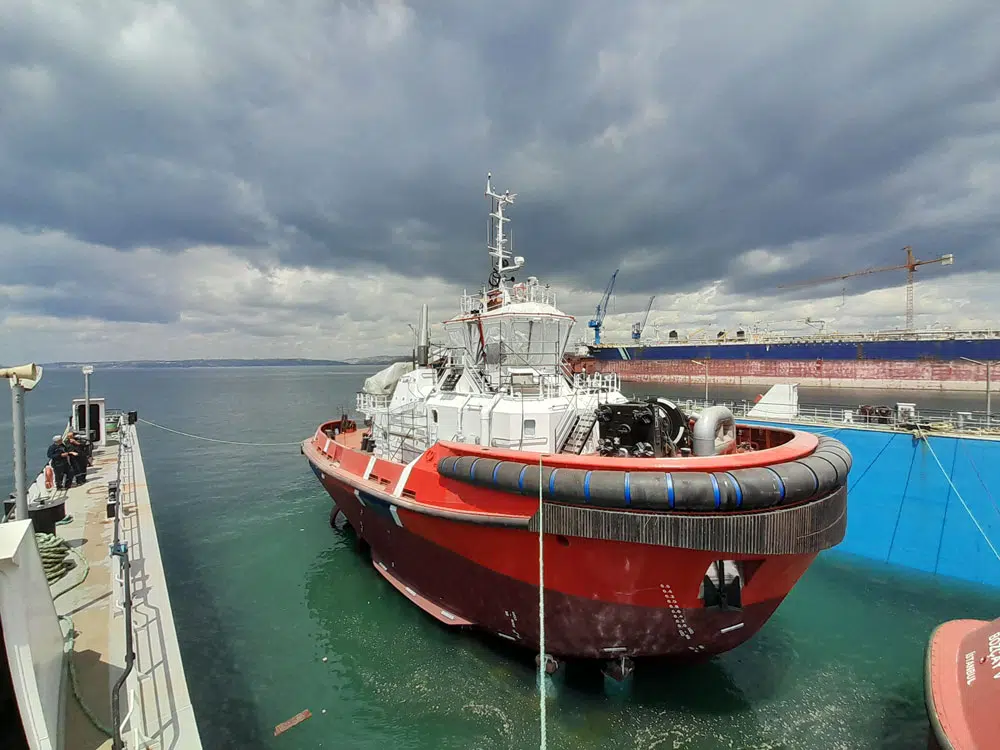
Turkish boatbuilder and tug specialist Sanmar Shipyards has launched what it describes as its first high-performance tugboat for a client in Greece. The newbuild, which was ordered by harbour towage and salvage fleet owner/operator NEMECA, is based on Canadian naval architect Robert Allan Ltd’s (RAL’s) RAstar 2900SX design, which was drawn up exclusively for Sanmar. This class features an overall length of 29.4m, a moulded beam of 13.3m and a moulded depth of 5.5m, and can accommodate a crew of up to 10.

The vessel is equipped to FiFi 1 firefighting capability and powered by a pair of CAT 3516E main engines, each rated 2,350kW at 1,800rpm. The builder says that this is sufficient to guarantee a bollard pull in excess of 80tonnes.

NEMECA’s fleet services Piraeus, Thessaloniki and Kavala, where, in addition to towage and salvage duties, it offers anchor-handling, rig-moving and supply-duty operations.

Rüçhan Çıvgın, commercial director at Sanmar, comments: “This is a relatively compact tug that punches well above its weight…outperforming larger rivals.”

UK consortium unveils floating wind installation vessel concept

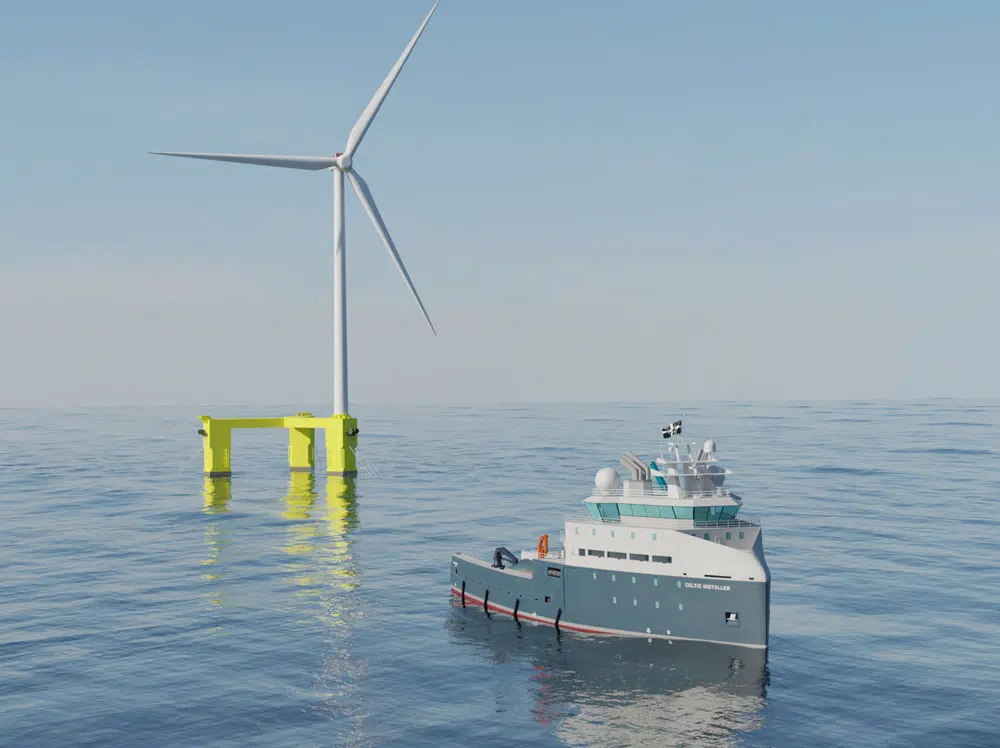
A UK consortium comprising Morek Engineering, Solis Marine Engineering, Tope Ocean, First Marine Solutions and Celtic Sea Power has devised a new class of floating wind installation vessel, primed for energy efficiency and sustainable operations. Having formally unveiled the concept at a Society of Maritime Industries event in London in May, the partners say they are now “advancing toward the next design stage” in the hope of attaining approval in principle (AiP) for the concept from a major class society by December.

Dubbed the Future FLOW Installation Vessel (FFIV) (the ‘FLOW’ standing for ‘floating offshore wind’), the ship would run on methanol and would feature a hydrodynamically optimised hull, azimuth thrusters and a DP2-rated dynamic positioning system. The vessel would also feature expanded mooring line capacity, care of a sizeable below-deck cable tank for synthetic mooring ropes, and lockers capable of holding “kilometres of chain”, the consortium states.

The partners envisage a length of 95m overall (or 88m between perpendiculars), a moulded breadth of 25m and a draught of 8.5m, with onboard accommodation provided for 42 personnel. The FFIV will also feature a tow winch and anchor-handling winch, a work-class ROV and a bollard pull capacity of 104te.

The consortium adds: “[The vessel] will work with any of the three main anchor types for floating wind turbines being considered by the industry: drag embedment anchors, which require installation by high-bollard pull anchor-handling vessels; suction piles; and driven piles, which require large subsea cranes to install them into the seabed. In each case, the FFIV meets the requirements of the next phase by installing the mooring lines onto the installed anchors, enabling quick connection to floating foundations towed to the offshore site.”

The project was conducted as part of the Clean Maritime Demonstration Competition Round 4 (CMDC4), a £206 million initiative to decarbonise the UK domestic shipping sector, funded by the UK Department for Transport and delivered by Innovate UK. Catch the July 2025 issue of The Naval Architect for more on this vessel, including an interview with Bob Colclough, naval architect, MD and founder of project lead Morek Engineering.

Repair round-up: yards form green alliance

Shipyards form green alliance

Four leading shipyards have co-founded the Global Green Shipyard Alliance (GGSA), an international coalition committed to accelerating the maritime industry’s sustainability transition. The alliance aims to fast-track clean technology adoption, improve environmental performance and set unified ESG standards across their global operations.

Dubai’s Drydocks World is one of the four founding members of the GGSA, alongside Astilleros Shipyard Group, Spain; BREDO Dry Docks, Germany; and IMC Shipyard Services Group, which has facilities in Singapore, China and Thailand. By creating a platform for knowledge sharing, joint development and scalable innovation, the GGSA says it seeks to deliver a range of practical solutions, from hybrid propulsion and energy-efficient retrofits to digital optimisation and emissions compliance.

Imran Inamdar, Drydocks World COO, comments: “Through the GGSA, we have an opportunity to work alongside our peers to drive measurable improvements across shipbuilding and retrofitting practices. This collaboration enables us to raise performance standards, improve operational outcomes and bring practical solutions to market faster.”

Seatrium secures FSRU conversion contract

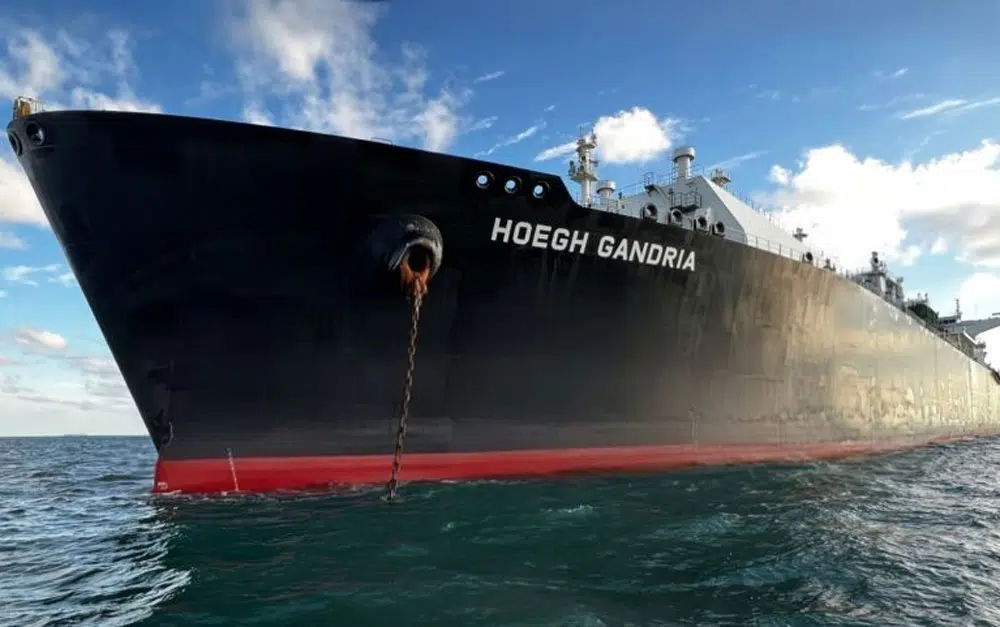
The Singapore shipyard group Seatrium has confirmed a significant contract award from Höegh Evi for the conversion of the LNG carrier Höegh Gandria into a floating storage regasification unit (FSRU). The work scope includes the installation of a regasification skid and integration of critical supporting systems such as cargo handling, utilities, offloading, electrical and automation systems. Engineering work started in May this year, with the 18-month project culminating in the FSRU’s deployment to the LNG terminal at Port of Sumed, Egypt, under charter by Egyptian Natural Gas Holding Company (EGAS).

In recent months Seatrium has also completed six cruise ship retrofits: Norwegian Spirit from Norwegian Cruise Line; Queen Elizabeth from Carnival UK Maritime; Star Voyager from Star Cruises; Le Laperouse and Paul Gauguin from Ponant Explorations Group; and Regatta from Oceania Cruises. In addition to routine docking and maintenance, Seatrium carried out  energy efficiency improvements and enhancements to the underwater propulsion systems.

Colombo Dockyard completes first-ever cable layer repair project

Colombo Dockyard recently completed drydocking repairs for Ile De Brehat, a 139.7m long cable lay vessel owned by Alcatel Marine Networks. The project was initiated by Louis Dreyfus Armateurs (LDA), the vessel’s technical managers.

While this is a first in terms of repairs for the Sri Lankan yard, Colombo Dockyard already has a proven track record in cable layer construction, having delivered two such vessels within the past five years to customers in Japan and France. Beyond routine drydock maintenance, Ile De Brehat underwent cable-laying equipment repairs, the replacement of cable strong points, A-frame and crane cylinder overhauls and the installation of the Nereus active heave compensation (AHC) and offshore burial lay systems (OBLS). Additionally, the shipyard carried out propulsion machinery overhauls and accommodation refurbishments.

Sea Dart takes on multipurpose underwater roles

As a developer of cruise missiles and recon systems, and with the US government as a key customer, it’s fair to say that Virginia-based Leidos has cut its teeth on defence solutions.  However, the company’s latest unmanned unwater vehicle (UUV), the Sea Dart, is designed to support both naval and commercial customers, undertaking tasks ranging from mine countermeasures and battlespace preparation to undersea asset inspections (including around oil rigs and wind farms) and environmental sensing. The concept is for a modular, payload-agnostic bot, obviating the need to deploy separate UUVs for different applications. 

The UUV is available in two configurations. The 1.63m-long Sea Dart-6, named for its full diameter of 6” (152mm), weighs 29.4kg, can descend to 600m and exceeds 12knots, with an endurance of 11-19 hours. The Sea Dart-9, meanwhile, weighs 54.3kg and features a length of 1.57m, a diameter of 9” (229mm) and a speed of 8knots. This model appears to be the pick for lengthier, higher-payload missions in less remote waters, given its 19-hour+ endurance and depth rating of 300m. 

The Sea Darts are powered by lithium-ion batteries – rated 1.1kWh for the Sea Dart-6, 2.2kWh for the Sea Dart-9 – and each variant incorporates a direct-drive DC brushless motor with a three-bladed propeller, plus four control fins for pitch and yaw. A modular hull section measuring 26.5” (673mm) can be added, should end users require a larger battery spread for an endurance boost. The vehicles come with dual-band 2.4/5 GHz WiFi.  

Dave Lewis, Leidos senior VP of sea systems, adds that the Sea Dart is compatible with the US Navy’s unmanned maritime autonomy architecture (UMAA) – a standardised, modular and scalable software framework designed to support both UUVs and USVs. Leidos’ portfolio includes medium-sized USVs such as the Sea Castle force multiplier and the 40knot-capable Sea Archer, a UUV designed for intelligence, surveillance and reconnaissance (ISR) work in high-risk waters.  

Leidos is particularly keen to stress the Sea Dart’s relative affordability: with a base cost of approximately US$150,000, both variants of the vehicle will cost “up to 80-90% less than other small UUVs with similar performance”, the company claims. This cost efficiency is partly credited to the use of commercial off-the-shelf components to reduce production costs and speed up manufacturing times, and partly to the Sea Dart’s open architecture model, which allows it to integrate with various software systems and payloads without the need for proprietary or specialised hardware. The UUV also uses common tech elements across its two (and future) variants to reduce lifecycle costs and maintenance expenses.  

As a result, Leidos envisages a strategy of high-volume production, stating that it aims to initially produce 180-200 Sea Dart units yearly. This should tie in with the US Department of Defense’s ongoing Replicator initiative, which is focused on the rapid scaling of unmanned systems, including sea drones and minimal-crew/zero-crew vessels, using commercial technologies. Although not explicitly confirmed by Leidos, the Sea Dart’s low cost and UMAA compatibility suggest it could support swarm tactics for operations such as minefield mapping, for example.  

Now, a 12.75” (324mm)-diameter version of the vehicle is “under consideration”, Leidos reveals. 

Keeping an AI eye on safe speeds

Having saved more than 6,400 lives in its 130+ year history, the Norwegian Sea Rescue Society (Redningsselskapet) is a cornerstone of maritime safety in Norway. Like many rescue agencies, though, the Society often must negotiate treacherous sea conditions at high speeds, raising the risk of severe slamming – a threat to volunteer first responders, onboard casualties and the boats alike – and this is especially the case off Norway’s rugged coastline. 

Earlier this year, Redningsselskapet decided to make Hefring Marine’s Intelligent Marine Assistance System (IMAS) a staple of its operations, building on a relationship that goes back to 2020, “when the IMAS was still in its infancy” Hefring Marine’s head of sales, Michael Given, tells The Naval Architect. This long-standing partnership has also enabled Redningsselskapet to provide feedback to Hefring Marine, enabling the company to tweak the IMAS in response to end-user recommendations. 

 At the time of writing, eight Redningsselskapet vessels were reported to be using the IMAS, though the Society intends to roll the system out across its entire 50+ vessel fleet between now and 2026.  

The IMAS was developed to undertake multiple human-machine interface (HMI)-related roles, such as helping crew to avoid excessive slamming and to keep tabs on their vessels’ energy consumption. In the case of the Redningsselskapet contract, the emphasis was on crew safety and rescue boat integrity.  

The system’s key features include its ‘safety speed’ predictive AI model. Given explains: “The model captures various types of real-time information – such as the engine data, weather info or any other useful data from the onboard sensors – and then compares that to historical data and decides the safest speed for the vessel, based on the sea conditions it is currently in. This is to avoid high G-force impacts and potential damage to the vessel and people on board.” 

This is important, Given adds, because there is no ‘one size fits all’ approach to determining a safe speed. “Some of the Redningsselskapet boats include ambulance vessels with critically ill patients on board, who really don’t want to experience slamming,” he says. “For these boats, users can set a G-force tolerance limit on the IMAS to minimise impacts at a specific location on board, such as a patient’s bed, using an additional sensor. 

“But, on fast response vessels, crew need to set that limit a bit higher – to, say, 3-4Gs – because those vessels have a different operational profile: they’re going hell-for-leather and can accept a bit more punishment than ambulance boats. They just need to make sure the vessel isn’t damaged and to keep the crew safe.” 

The IMAS console displays two speeds: the vessel’s current speed over ground and the ‘safety speed’ required to keep the boat and crew safe, which is calculated from the abovementioned data. “The safety speed fluctuates in real time,” Given says, “so, if you enter a rough-water area, that speed will come down. If your speed over ground exceeds the safe speed, the whole dial goes red and warns the operator that you need to slow down now or you’re likely to have an impact over your threshold.” 

The alert is sent to the bridge but can also be relayed back to shore, via the cloud. “Red-alert impacts are recorded, so you can look back and see which conditions led to those impacts,” Given adds. “That’s something that can help with insurance concerns – but also can help naval architects and boatbuilders to redesign existing boats, for enhanced safety.” 

As an example, Given recalls an incident off the coast of Iceland, where a search and rescue (SAR) boat was hit on the bow by a freak wave rolling out of harbour. The impact, which was measured at 7.8Gs, broke the boat’s engine mounts and cracked some of its welds.  

“The IMAS was paramount in understanding what happened in that incident,” Given says. Using this info, which included a 3D model highlighting the velocity with which the wave hit the boat, the boatbuilder and naval architect were able to analyse the ‘weak points’ of the current design – in this case, the intersection between the cabin, the stringers and the beam – and to make modifications to refine the design to be more robust.  

While avoiding heavy slamming is obviously a big issue, the IMAS can also help operators to reduce their energy consumption and emissions, care of the system’s ‘eco speed’ functionality.  

Like the safety speed option, the system’s eco speed mode gathers real-time info on the most fuel-efficient speed to pursue in the boat’s current environment. As Given explains, Hefring Marine’s client base for the IMAS includes everything from “large fishing trawlers to small, fast RIBs” – and so, again, determining an eco-friendly speed depends on each individual vessel type and its operational environment. 

'Neoliner Origin' goes back to the future (of sailing)

Neoline’s dream is taking shape, writes Bruno Cianci. Following the January launch of Neoliner Origin, which took place at the RMK Marine facility in Tuzla, Istanbul, this 136m, sailing and diesel-electric ro-ro cargo vessel will enter service connecting the Atlantic coast of France with the port of Baltimore, making intermediate calls in St. Pierre & Miquelon and Halifax (Nova Scotia). Like the ship in question, this transatlantic route is a first of its kind, offering new destinations and involving a vast spectrum of rolling and non-standard freights, including refrigerated containers and oversized parcels.

The cargo carrier will have a commercial speed of 11knots and a monthly frequency. The distance between St. Nazaire and Baltimore will require 13 days of travel westbound and 15 days eastbound. Thanks to an extra 3knot speed margin to which the operator can resort in the event of delay, Neoline will ensure regularity and punctuality in departures and arrivals, thus meeting clients’ needs and deadlines.

Conceived in 2011, Neoline was born out of the determination of an informal group of nine professionals, led by ro-ro ship captain Michel Péry, all determined to create and optimise new propulsion methods and achieve a substantial drop in CO2 emissions. The team shared a conviction that sails are the only solution: immediately available and powerful enough to propel heavy cargo vessels. As well as exploiting the wind as its primary driving propulsion, though, the vessel is supported by auxiliary diesel-electric power, enabling the vessel to maintain its sailing schedule.

The ship is fitted with twin carbon-mast SolidSail rigs, designed by Chantiers de l’Atlantique, that can be folded down to clear bridges and to access most ports. Each mast can hoist one 1,050m2 SolidSail and one 450m2 jib (by Onesails), totalling 3,000m2 of canvas. Below surface, the ship features deep retractable anti-drift fins, designed by Fouré Lagadec, that prove efficient and particularly useful while sailing upwind.

Equipped with a 12m-wide loading ramp, Neoliner Origin can handle a wide range of parcel sizes and packaging in three loading areas (a 2,100m2 main garage, a 500m2 twin deck and a 950m2 lower garage), all weatherproofed. Its transport capacities are optimised to load both light freight (cars, pallets, etc) and oversized parcels, up to 9.8m high and 200tonnes in weight, without the need for lifting.

Neoliner Origin has two types of propulsion system: sails and a mechanical propeller. The latter comprises a controllable-pitch propeller connected to a PTI/PTO gearbox clutched to a diesel medium-speed, 3,200kW ABC engine and to a 900kW electric motor. This allows the powertrain to work efficiently in every possible configuration, and to integrate batteries in the future. Thus, there are three sail modes: exclusively sails; mechanical propulsion (mainly for manoeuvring); and hybrid.

Neoliner Origin aims to reduce its fossil fuel consumption by more than 80% compared to a same-sized conventional ship operating at 15knots. But there is more to the story, as Neoline technical manager Guilhem Péan explains: “Apart from fuel savings, our ship is much more silent than conventional motorised vessels, and therefore its impact on marine mammals and the environment is drastically lower. And of course, the less the engines and equipment are used, the less maintenance and spare parts or consumables are required. Besides, when the sails are in use, the vessel’s roll motion is dampened, and comfort thus improved.”

Neoline CEO Jean Zanuttini adds: “We are actively working on plans for other versions of Neoliner Origin. Our goal is to scale the concept and increase the capacity for cargo while progressing toward zero-emission shipping.”

Tech-friendly Abu Dhabi becomes 'ROC City'

From a US$3.5 billion push to become the world’s fully AI-native city by 2027, to this year’s roll-out of a fleet of self-driving robotaxis, tech vibes are strong in Abu Dhabi. Add recent reports of blockchain adoption, quantum research and a large-scale solar energy capture project, and the capital city of the UAE appears to be buzzing with innovation.

This tech-drive includes the launch this year of the UAE’s first dedicated remote operations centre (ROC) for USV testing, hiring and maintenance. Named ‘The Quarterdeck’ and scheduled to commence operations from Q3 2025, the ROC will be located at Addax Tower, a 60-storey commercial skyscraper located on Al Reem Island.

The Quarterdeck is the brainchild of long-term partners Nexus Remote Solutions and Janus Marine and Defense, and its chief aim is to enable start-ups and scale-ups to test-drive both commercial and defence-related USVs and UUVs. Jack Dougherty, owner of Janus Marine and Defense, tells The Naval Architect: “There just aren’t that many public ROCs out there. Currently, the UAE has three ROCs spanning the commercial and defence markets, yet all three are privately owned and closed to external contractors. The Quarterdeck is the first ROC in the UAE that will allow smaller-sized companies to get their hands on the same technology and facilities found in private ROCs, and to utilise a larger USV to its fullest capacity and take it offshore, including the use of satcomms, without having to invest in their own ROCs.”

John Woroniuk, Nexus founder, adds: “We’re open to small-to-medium-sized companies and surveyors who want to innovate USVs: mainly in the oil and gas industry but also the naval sector. The Quarterdeck is like an R & D centre where you can hire high-tech equipment and undertake vessel trials – and we can offer to operate manned or unmanned vessels for you. This enables companies to manage USV operations across the Gulf and beyond.”

What’s more, while attitudes toward USV development tend to vary from state to state in the US, and from country to country across Europe, Dougherty notes that the UAE offers “excellent conditions” for uncrewed vessel operations – most notably, an absence of red tape, while avoiding a literalistic interpretation of the SOLAS requirements. “The UAE government is especially receptive to technology that has the potential to boost health and safety,” Dougherty adds.

Last year saw the launch of the Nexus Janus (NJ) Portal, a hub developed by Janus, Nexus and Current Scientific Corporation to manage and integrate various USV sensors and payloads (including anything from cameras and side scan sonars to machine guns). The NJ Portal was first showcased at 2024 Autonomous Ship Expo and Conference in Amsterdam, where it was used to operate a pan-tilt-zoom electro-optical/infrared (PTZ EO/IR) camera based in Vancouver, plus a 12m USV in Abu Dhabi, simultaneously and in real time from a single laptop at the show. The NJ Portal’s reported benefits include the ability to compress and truncate high-speed data for seamless transfers between the USV and shore-based (or mothership-based) analysts.

The NJ Portal technology will be incorporated into The Quarterdeck. Dougherty explains that the facility will offer three soundproofed pods, each staffed by a trained USV pilot and two sensor operators. The Quarterdeck will also feature a larger conference room, for company presentations and live trials. The sensor operators will look after whatever payload gear needs to be demonstrated, whether that’s gripper tools, weaponry, a long-range acoustic device (LRAD) or a smaller ROV.

Dougherty says that users can either hire Unique’s USVs or run the tests on their own units, adding: “Another reason we established The Quarterdeck was that it seemed a missed opportunity for those companies shipping in their USVs for UAE shows like IMEX. They brought their USVs into the country at great cost but were then unable to test them or demonstrate them to clients – so we thought, you might as well keep them out here for a few months.” Similarly, he highlights: “Nobody in the UAE wants to fly all the way to Glasgow just to see how their USVs and their payloads perform in the North Sea.”

One ongoing issue with ROCs is the absence of international standards for pilots operating USVs remotely from another country. Regarding rules and regulations, Doughtery comments: “Obviously, if a ship is flagged in Panama and being run out of the North Sea, but the ROC is based in the GCC, that creates regulatory issues – but, to be transparent, nobody knows how to get over these yet. It took IMO four years to come up with its ‘four degrees of autonomy’ for maritime autonomous surface ships [MASS] labels, so, for now, I think we’ll have much more luck dealing with the local statutory and regulatory agencies.”